Robert Nickelsberg has spent over two decades photographing life in Kashmir. His images capture the daily realities of a region shaped by decades of conflict. Source: theguardian.com.
Conflict Without End
The Kashmir region has seen repeated cycles of violence, displacement, and political tension since the 1980s. These conflicts have left deep scars on communities, affecting generations.
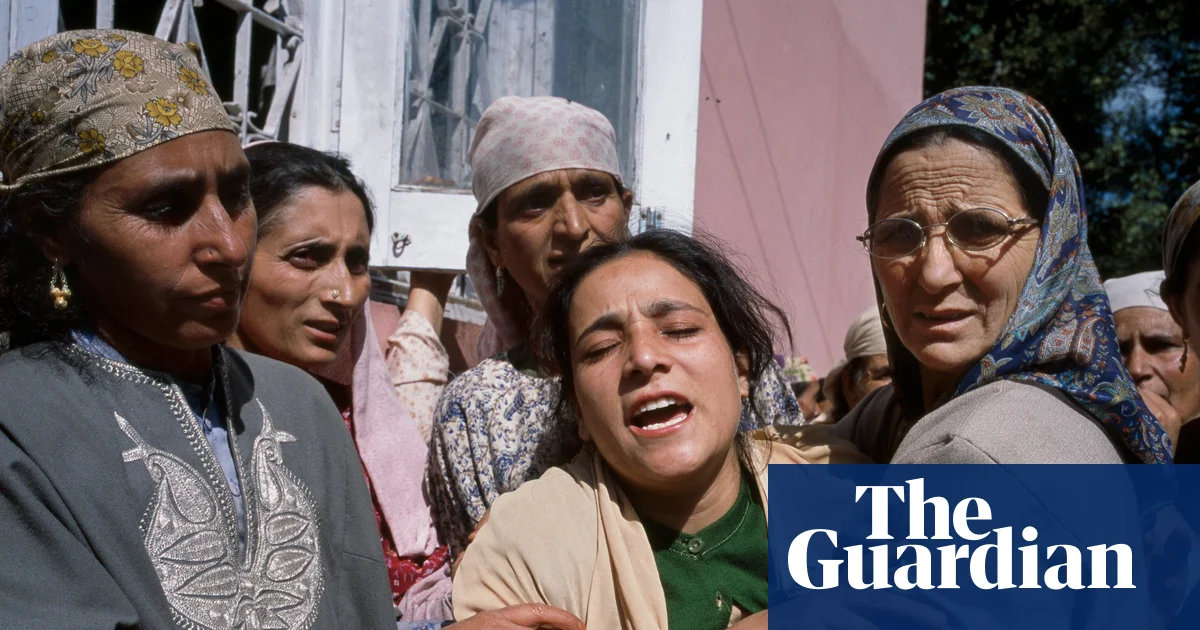
Nickelsberg’s work focuses on ordinary lives—children playing in villages, families gathering in homes, elders sharing stories. These scenes are not separate from the violence; they are its aftermath.
He says, ‘The trauma is not visible in grand gestures. It’s in the way people move, how they look at each other, how silence settles between them.’
Everyday Life in a War Zone
Many Kashmiri families live in homes that have survived bombings or been rebuilt after evacuations. Some still carry photographs of relatives who were lost in attacks.
One photo shows a woman in a traditional shawl, sitting on a low stool, her hands folded. Behind her, a wall bears a faded drawing of a tree. The tree is incomplete—its roots are cut short.
Another image shows children at a schoolyard. One boy is holding a toy airplane. The plane is painted in red and white, colors associated with the Indian national flag. But the wings are torn.
These images do not depict war as spectacle. They show how conflict has seeped into daily routines—how grief is carried quietly, how fear is embedded in gestures.
Community Resilience
Despite the trauma, community bonds remain strong. In some villages, people still gather for festivals, even if they are held in smaller, more private spaces.
One elder in a village near Srinagar says, ‘We don’t talk about the past much. But when someone is sad, we listen. That’s how we stay together.’
These moments of connection are not romanticized. They are fragile, and often interrupted by new waves of tension.
Photography as Witness
Nickelsberg’s photographs are not meant to explain or justify. They serve as records—of lives that continue, of people who endure, of spaces that remain.
His work is part of a broader effort to show the human side of conflict, not just the political or military.
His images have been exhibited in galleries across Europe and Asia. They are not widely known in mainstream media, but they have been used in academic studies on trauma and memory.
One scholar noted, ‘These photos don’t offer answers. But they show how people live with the weight of history.’
There is no official count of how many people have been affected by conflict in Kashmir. The United Nations and local governments have reported varying numbers. The situation remains fluid and sensitive.
While the region has seen periods of relative calm, violence has not ceased. Security operations and protests continue to occur, often with limited public transparency.
Nickelsberg avoids commentary in his work. His role is to present what he sees—not to interpret it.
He has received no formal recognition for his work in Kashmir. Yet, his photographs are widely respected in cultural and academic circles.
His project continues.
For now, the images remain a quiet testament to resilience. They do not offer closure. They simply show life—fragile, persistent, and deeply human.
Sources & further reading
Featured image: original publisher image. Via original publisher. Image source