What is Gemini 4 Neon?
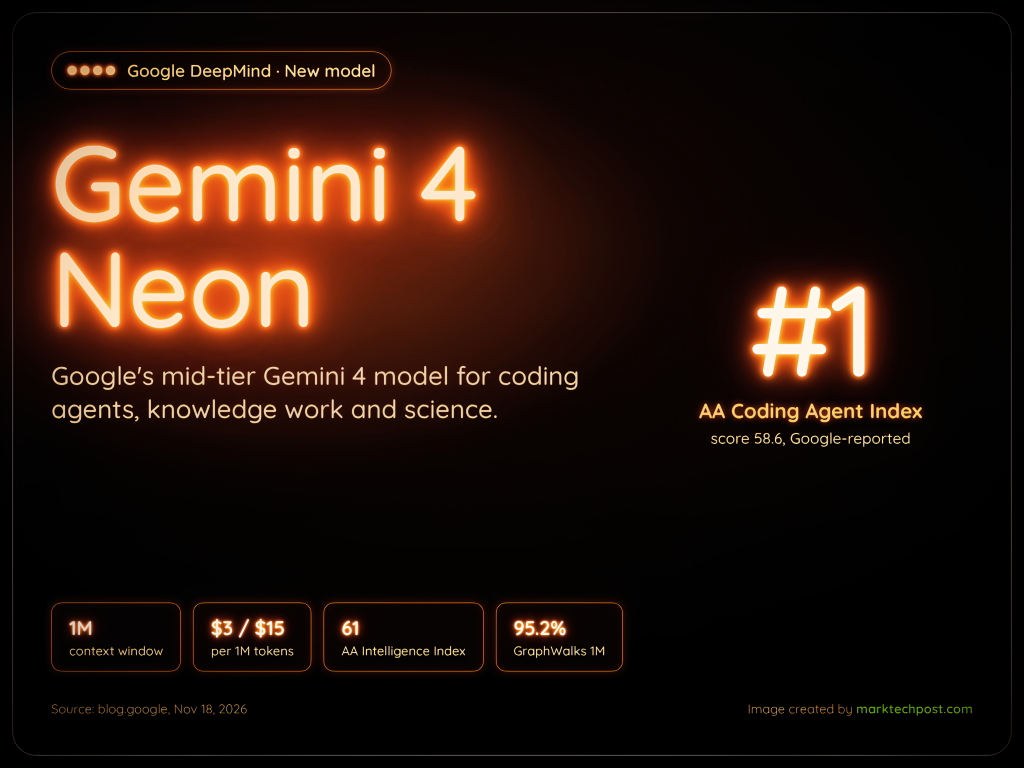
Google DeepMind has released Gemini 4 Neon, a reasoning model designed for agentic workflows and long-context tasks. It sits in the middle of Google’s Gemini 4 family, balancing the depth of Gemini 4 Carbon and the speed of Gemini 4 Hydrogen. Source: marktechpost.com.
Neon is adapted from Gemini 4 Carbon. Google has not disclosed its parameter count or architecture. This limits independent technical analysis but reflects Google’s focus on performance over public detail.
Neon supports text, images, audio, and video inputs. Its knowledge cutoff is March 2026, ensuring it includes current information while maintaining a stable training boundary.
How Does Gemini 4 Neon Work in Agent Workflows?
Neon offers two thinking levels: ‘High’ for most tasks, and ‘xhigh’ for complex engineering, scientific, and analytical workloads.
For long-running agent processes, Neon uses context compaction to reduce redundant file reads and optimize memory. This improves efficiency in extended workflows, such as software development and scientific research.
In Google Antigravity, Neon acts as an orchestrator. It directs parallel Gemini 4 Hydrogen subagents to handle smaller, specialized tasks. This allows complex workflows to be broken down and managed efficiently.
Performance Benchmarks: How Does Neon Compare?
Neon leads on the AA Coding Agent Index with a score of 58.6. It achieves 39.0% success in SWE-sweep—over three times higher than Claude Opus 5.5’s 10.1%.
On knowledge work, it scores 56.3% on Zapier AutomationBench and 75.8% on Agents’ Last Exam v1.1. These show strong performance in automation and reasoning tasks.
Neon scores 84.0% on RiemannBench, 70.5% on Terminal-Bench-Science, and 71.3% on HLE-Diamond in science and reasoning tasks.
Its standout strength is long-context recall. On GraphWalks (256K to 1M context), it reaches 95.2% accuracy—outperforming Claude Opus 5.5’s 66.8%.
However, it does not win all benchmarks. Opus 5.5 leads on Terminal-bench 4.1 (65.8% vs 65.2%) and FrontierCode 2.0 (47.3% vs 46.2%). GPT-6.2 Sol beats it on Chartography (75.1% vs 73.5%).
On the Vals Index, Neon scores 70.9% and ranks second. On the Agent Arena index, it scores 1336 and ranks second—showing strong overall agent-level performance.
What Does Gemini 4 Neon Cost?
Neon costs $3 per 1M input tokens, $0.15 per cached input, and $15 per 1M output tokens.
At high thinking levels, it costs 32% less per task than Carbon. Google claims 50% to 80% lower cost per task than rivals on the Vals Index and Agent Arena.
At xhigh settings, Neon is 36% or more cheaper than competitors under peak performance. These are per-task metrics, not per-token prices.
For comparison, GPT-6.2 Sol lists at $2/$10, and Claude Opus 5.5 at $4/$20. Gemini 4 Carbon is $2/$10 until November 30, then $4/$20.
Where Can Developers Use Gemini 4 Neon?
Developers can access Neon through the Gemini API paid tier (via Google AI Studio and Android Studio).
It’s available in Gemini for Business via API and model dropdown.
Neon runs in Google Antigravity for paid Google AI Pro and Ultra subscribers.
It’s also available in the Gemini app for Pro and Ultra subscribers.
Safety and Security Features
Neon runs on the Gemini 4 safety and security stack. It reports a 0.09% misaligned action rate on its agentic safety suite.
It passes 99.2% of agent honesty evaluations. On Gray Swan’s prompt injection benchmark at the highest thinking level, it shows a 0.0% attack success rate.
Its 2.45% shortcut rate on a coding cheating test is the lowest of any Gemini 4 model—indicating strong integrity in code generation.
Key Takeaways
Neon is the middle model in the Gemini 4 family, priced at $3/$15 per 1M tokens.
It scores 61 on the AA Intelligence Index and ranks first on the AA Coding Agent Index.
Its biggest lead is 95.2% on GraphWalks long-context recall.
It trails Opus 5.5 on Terminal-bench 4.1 and FrontierCode 2.0.
Neon is closed-access and API-only. All benchmarks are self-reported by Google.
Check out the launch post and model card. You can find deployment options and specs through our GPULeaderboard.com chrome extension.
Follow us on Twitter and join our 150k+ ML SubReddit. Subscribe to our newsletter. Are you on Telegram? Join us there too.
If you’d like to partner with us to promote your GitHub Repo, Hugging Face Page, Product Release, or Webinar, connect with us.
Asif Razzaq is the CEO of Marktechpost AI Media Inc. As a visionary entrepreneur and engineer, he is committed to harnessing AI for social good. His platform, Marktechpost, offers in-depth, technically sound coverage of machine learning and deep learning news. It reaches over 2 million monthly views.
Sources & further reading
Featured image: original publisher image. Via original publisher. Image source