The most common interview questions feel simple, but they decide whether you move forward. The trick is to use a repeatable structure that is confident, specific, and relevant to the role.
This guide gives you copy-ready frameworks + examples you can tailor in minutes.
1) “Tell Me About Yourself” — The Best Structure (60–90 seconds)
Most people either:
- repeat their CV word-for-word, or
- tell a life story.
Instead, use Present → Past → Proof → Future.
The Formula
Present: Who you are professionally now
Past: The most relevant experience/skills you built
Proof: 1–2 measurable results or achievements
Future: Why this role/company fits what you want next
Example Answer (General, Works for Most Roles)
“I’m a detail-focused professional with experience supporting operations and customer-facing work, where I’m used to balancing accuracy with speed. Over the last few years I’ve built strong skills in organising information, handling requests, and improving processes so teams can work smoothly. For example, in my last role I reduced delays by introducing a simple tracking system and improved response times by standardising templates. I’m now looking for a role where I can bring that mix of organisation, communication, and problem-solving—especially in a team that values continuous improvement.”
Example Answer (IT / Service Desk Style)
“I’m an IT support professional with experience troubleshooting common user issues, managing tickets, and communicating clearly with non-technical users. I’ve worked in fast-paced environments where priorities change quickly, so I’m comfortable following SLAs, documenting accurately, and escalating appropriately. Recently I helped reduce repeat issues by creating short user guides and improving ticket notes for handovers. I’m now looking to join a service desk team where I can grow my technical depth and contribute to strong customer experience.”
Example Answer (Entry-Level / Career Change)
“I’m transitioning into a new role after building strong transferable skills in customer support and structured admin work—especially communication, attention to detail, and working under pressure. I’ve been upskilling through courses and practical projects, and I’m confident using tools like spreadsheets, documentation, and standard processes. I’m now focused on a role where I can apply those strengths and keep learning in a supportive team.”
Tip: Don’t mention personal details. Keep it professional, relevant, and forward-looking.
2) “What Are Your Strengths?” — Choose 2 Strengths + Proof
The best strengths are:
- directly useful for the job, and
- backed by a story or result.
The Formula
Strength: “One of my strengths is…”
Evidence: short example + metric (if possible)
Relevance: “That’s useful here because…”
Strong Strengths to Choose From (Pick 2)
- Clear communication (especially under pressure)
- Ownership / reliability
- Analytical thinking / problem solving
- Attention to detail / accuracy
- Prioritisation / time management
- Collaboration / stakeholder management
- Learning agility (fast learner)
Example Answer (Operations/Admin)
“One of my strengths is prioritisation. I’m used to working with competing requests, so I quickly clarify urgency, deadlines, and impact. In my previous role I introduced a simple triage method that reduced missed deadlines and made handovers clearer. That’s relevant here because this role needs someone who can stay calm, organise work, and keep things moving.”
Example Answer (Customer Service)
“My strengths are communication and empathy. I’m good at understanding what someone actually needs, especially when they’re frustrated, and turning that into a clear next step. In my last role I consistently received positive feedback and helped reduce escalations by resolving issues at first contact. That matters here because great customer experience depends on clarity and trust.”
Example Answer (IT / Tech Support)
“A key strength is structured troubleshooting. I follow a method—confirm the issue, isolate variables, test fixes, and document the resolution. This helped me resolve common issues quickly and build a knowledge base that reduced repeat tickets. That’s useful here because your team works to SLAs and depends on consistent documentation.”
3) “What’s Your Biggest Weakness?” — The Safe Way to Answer
Bad answers:
- “I’m a perfectionist” (too cliché)
- “I’m bad with people” (red flag)
- anything that’s central to the job.
Good answers show:
- self-awareness,
- action,
- improvement.
The Formula
Weakness (real but non-critical):
Impact: what it used to cause
Fix: what you changed
Result: what’s better now
Strong Weakness Options (Choose One)
- Overcommitting (now you set boundaries and priorities)
- Nervous presenting (now you prepare and practice)
- Asking for help too late (now you escalate earlier)
- Too detail-heavy (now you timebox and summarise)
Example Answer (Professional + Safe)
“Earlier in my career I sometimes took on too much because I wanted to be helpful. The downside was that I’d have a very full workload. I’ve improved that by clarifying priorities early, giving realistic time estimates, and flagging conflicts sooner. It’s made my delivery more consistent and helped teams plan better.”
Example Answer (IT / Service Desk)
“One area I worked on is escalating earlier when something is outside my scope. I used to try to solve everything myself, which can slow resolution. Now I follow a clear escalation rule: if I’ve tested the core steps and there’s no progress within a set time, I escalate with strong notes and evidence. That protects SLAs and improves customer outcomes.”
4) “Explain Your Employment Gap” — Calm, Simple, Future-Focused
You don’t owe a long personal story. Employers want to know:
- Is there a risk?
- Are your skills current?
- Are you ready now?
The Formula
Brief reason (1 sentence) → what you did → why you’re ready now
Example Answers (Copy-Ready)
Gap: Caregiving / Family
“I took time out for family responsibilities. During that period I kept my skills current with online learning and stayed organised with structured routines. I’m fully ready to return to work now and I’m excited to commit long-term.”
Gap: Health (keep it vague)
“I had a health-related break that’s now resolved. I used the time to reset, stay current with my skills, and plan my next step. I’m ready to work reliably and I’m looking forward to bringing my focus back into a team environment.”
Gap: Redundancy / Job market
“After redundancy I took time to target roles carefully and upskill. I completed training, updated my CV, and focused on roles where I can add value quickly. I’m now ready to step into a position like this and contribute from day one.”
Gap: Study / Career change
“I used that time intentionally to retrain and build relevant skills through courses and practical projects. I’m now looking for a role where I can apply what I’ve learned and continue developing.”
Important: Keep it confident. Don’t apologise. Don’t overshare.
5) Mini Scripts for Other Variations You’ll Hear
“Why should we hire you?”
“Because I bring [2 key skills] and I’ve demonstrated them through [short proof]. I work reliably, communicate clearly, and I’ll contribute quickly while continuing to learn.”
“Why do you want this role?”
“This role fits my strengths in [skills] and the way your team works—[specific detail]. I’m looking for a long-term position where I can grow and deliver consistent results.”
“Where do you see yourself in 3–5 years?”
“Growing in responsibility and expertise—becoming a strong contributor and taking ownership of bigger projects. I’m motivated by continuous improvement and measurable impact.”
6) The Quick Customisation Checklist (Before Any Interview)
In 10 minutes:
- Read the job advert and highlight top 5 skills
- Match each skill to one proof point from your experience
- Prepare:
- 60–90 sec “About me”
- 2 strengths + proof
- 1 weakness + improvement
- 1 gap explanation (if needed)
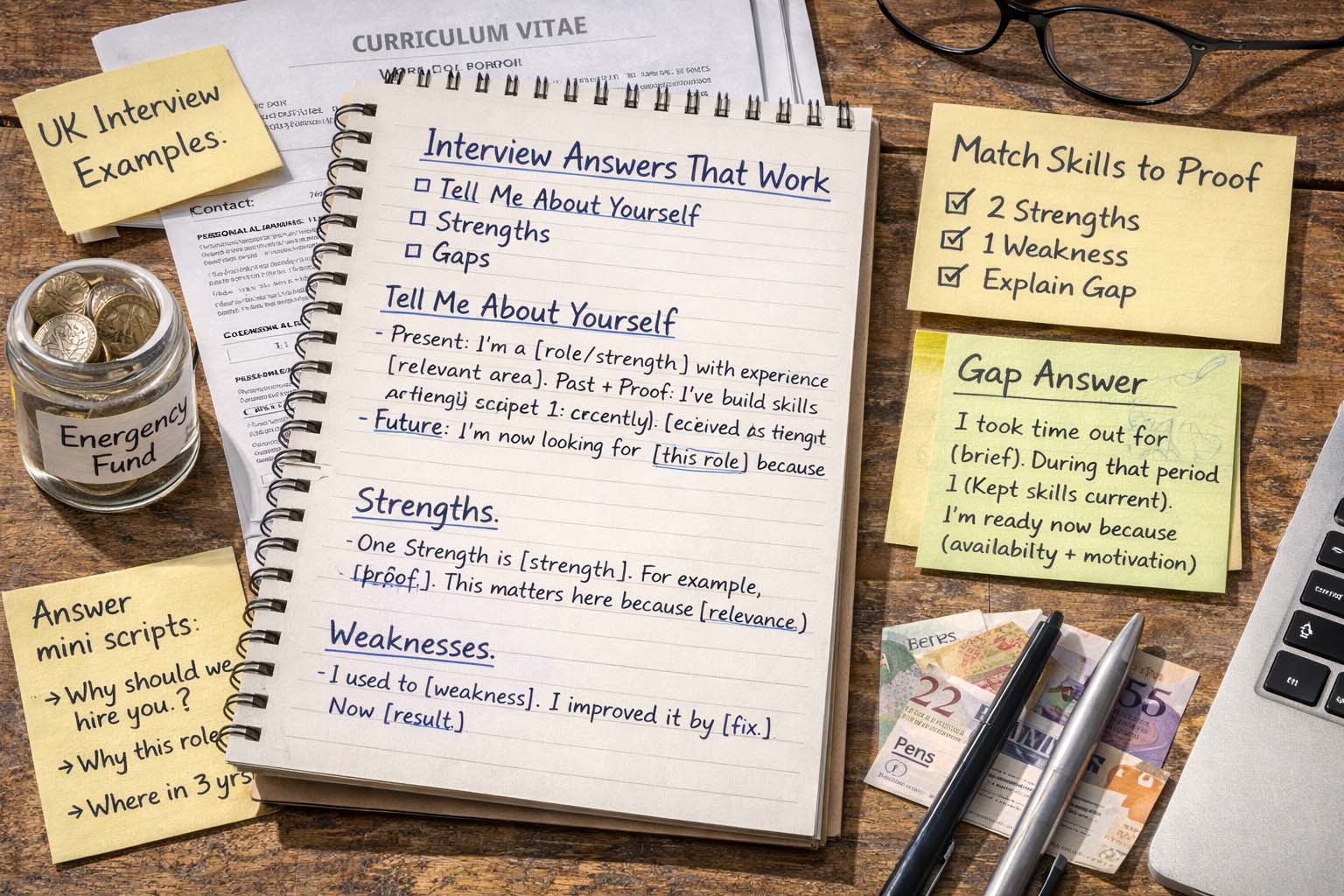
7) Template You Can Paste and Fill In
Tell me about yourself:
“I’m a [role/strength] with experience in [relevant area]. I’ve built skills in [skill 1], [skill 2], and [skill 3]. Recently I achieved [result]. I’m now looking for [this role] because [fit].”
Strengths:
“One strength is [strength]. For example, [proof]. This matters here because [relevance].”
Weakness:
“I used to [weakness]. I improved it by [fix]. Now [result].”
Gap:
“I took time out for [brief]. During that time I [kept skills current]. I’m ready now because [availability + motivation].”
Final Thoughts
The best interview answers are short, specific, and proven. If you use the structures above and add your own proof points, you’ll sound confident and prepared — without memorising robotic scripts.
If you want, paste the job title + job description, and I’ll tailor:
- a 60–90 second “Tell me about yourself”
- 2 strengths + examples
- a safe gap explanation
…all matched to that exact role.