The Kvareli Foundation for Contemporary Art has opened in Georgia’s Kakheti region, marking a new chapter in the country’s art history. It is a privately funded initiative that aims to showcase a broader, more inclusive narrative of Georgian art—particularly works that existed outside the state-sanctioned socialist realism of the Soviet era. Source: artnews.com.
From Tokyo to Georgia: A Personal Inspiration
Jemal Inaishvili, a shipping executive and art collector, recalled a trip to Naoshima Island in Japan. There, visitors travel by boat to see modern art installations in a remote location. The journey, though lengthy, becomes part of the experience—traveling to a place not easily accessible by conventional means transforms the act of viewing art into a journey of discovery and cultural immersion.
He adapted that idea for Georgia. The drive from Tbilisi to Kakheti takes about two hours, making it accessible. He envisioned a similar cultural journey—where people could travel to see art that reflects local identity and history. Unlike Naoshima, which requires a full day of travel and a boat ride, the Kakheti route is a manageable commute, yet it still offers a sense of departure from the daily rhythm of urban life. This accessibility allows for a more intimate connection between the viewer and the art, especially when the art is deeply rooted in local traditions and personal histories.
For Inaishvili, the journey from Tokyo to Naoshima was not just about the destination—it was about the transformation of perspective. The act of traveling to a remote place, away from the familiar, reorients one’s view of art as something that exists beyond the confines of major cities or institutional galleries. In Georgia, he sought to replicate that shift, not through distance, but through proximity and cultural resonance. The foundation is not merely a museum—it is a cultural ecosystem designed to invite people into a deeper engagement with their own national identity through art.
The Foundation’s Structure and Mission
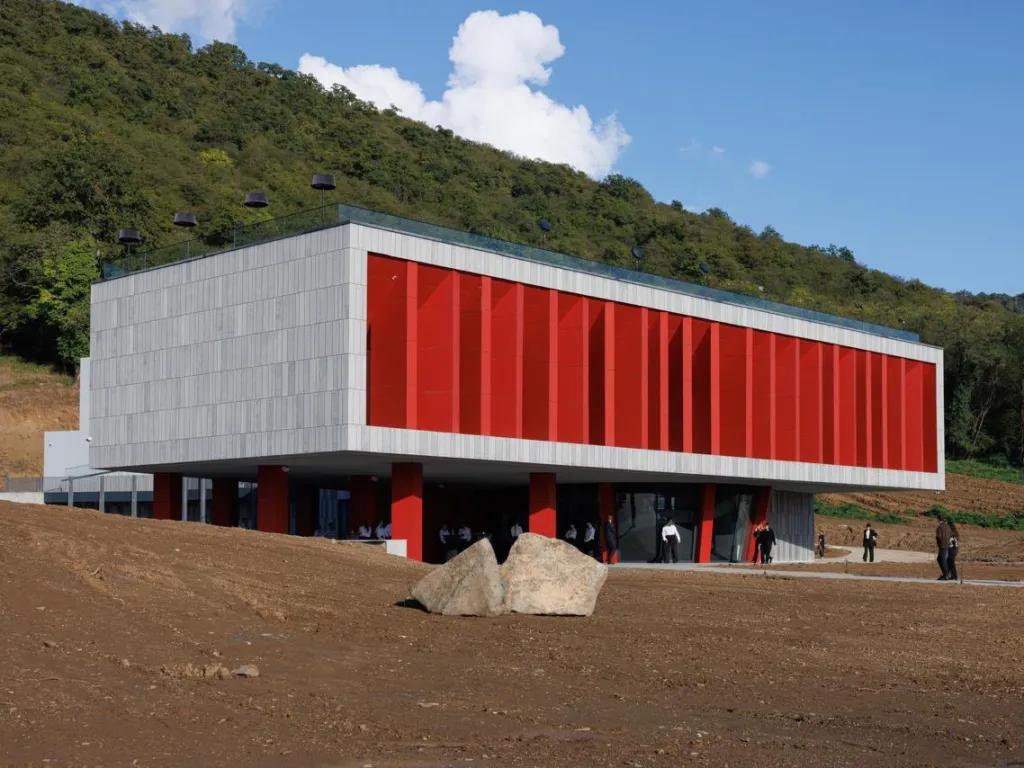
The Kvareli Foundation now operates on land Inaishvili purchased a decade ago for a winery. It now includes a hotel, a sculpture park, and a red-slatted museum with a rooftop for performances and film screenings.
The museum is admission-free and will host four exhibitions annually. It draws from Inaishvili’s collection of about 1,000 artworks. The foundation’s programming is led by 28-year-old Nino Sulkhanishvili, who is in her first institutional role as creative director.
She sees her role as building infrastructure for Georgian artists to exhibit at home. A solo show by Elene Chantladze will open in February. Sulkhanishvili emphasizes decentralization: art should not be confined to major cities. By situating the foundation in Kakheti, a region known for its wine and rural landscapes, she is challenging the idea that art must be centralized in urban hubs like Tbilisi.
Next year, the foundation will launch a residency program for both local and international artists. This will help foster regional artistic exchange and support emerging talent. The residency will provide artists with space, time, and mentorship to develop new work, with a focus on creating pieces that reflect both personal and regional narratives. These programs are designed not only to produce art but to cultivate a community of practice where artists can learn from one another and from the land itself.
Artistic History in the Exhibition
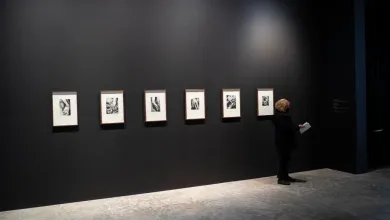
The inaugural exhibition, Georgian Contemporary Art: Origins and Continuities, runs through January 15. It features 57 artists from the 1960s to the present. Roughly half of the works come from Inaishvili’s collection; the rest are on loan.
It intentionally excludes artists from the Soviet-era doctrine of socialist realism. This is a deliberate choice, as many such artists have been omitted from official narratives. The exhibition does not present a linear progression of art history, but rather a network of creative responses to political, social, and personal realities.
The exhibition begins with the cultural thaw after Stalin’s death in 1953. Foreign art magazines like ARTnews and Art in America began to reach Georgia. Shura Bandzeladze, a pioneering Georgian abstract expressionist, saw a black-and-white image of Jackson Pollock and felt validated. This moment marked a turning point—artists began to see themselves as part of a global artistic conversation, not just as products of a state-imposed aesthetic.
Artists faced real risks under Soviet rule. Ushangi Khumarashvili, a set designer from Telavi, clashed with his director and was sent to a psychiatric hospital. After release, he burned his earlier work and turned to abstraction. This act of self-destruction and reinvention symbolizes the personal cost of artistic dissent. Similarly, Otar Chkhartishvili participated in the unapproved 1974 Bulldozer Exhibition in Moscow, which authorities violently ended. These events were not just artistic experiments—they were acts of resistance.
In Levan Chogoshvili’s painting 1924 (ca. 1980s), a dog carries a severed human hand—based on his grandmother’s account of Bolshevik executions. These events were omitted from official Soviet histories. The painting is not merely a depiction of violence—it is a memory passed down through generations, a testament to the trauma of history that was never officially acknowledged.
In 1978, Irakli Parjiani began writing the Gospels by hand and illustrating them in medieval styles. Irena Popiashvili, dean of Tbilisi’s Free University’s Visual Arts program, described this as a ‘revolutionary act’ in a state that officially denied religion. This work reflects a broader trend: artists began to reclaim spiritual and cultural traditions that had been suppressed under Soviet ideology.
Hope and Change in the 1990s
During perestroika, there was a sense of optimism. Artists began building their own scenes and creating larger-scale works. The 10th Floor group, based at the Tbilisi State Academy of Arts, moved into a theater workshop to realize monumental paintings. This shift from studio to performance space reflects a growing confidence in the possibilities of art as a form of public expression.
Artist and art historian Karlo Kacharava introduced his peers to Western writers. One artwork in the exhibition pays tribute to Allen Ginsberg. This exposure to Western literary traditions helped shape a new generation of Georgian artists who saw art not as a tool of state control, but as a medium for personal and political exploration.
Keti Kapanadze, considered Georgia’s first woman conceptual artist, created the Probable Need series (1990). She used over a dozen self-portraits, portraying herself as ‘Native,’ ‘Mystery,’ and ‘Gentleman’—a play on gender and identity. Her work challenges the rigid gender roles of Soviet society and offers a space for self-reflection and ambiguity.
Humor and Memory in Post-Soviet Art
After the 1990s, war and chaos in Abkhazia were reflected with bitter humor. Kote Sulaberidze’s video Playing War (1994) reenacts the 1992–93 conflict as a children’s game. His portrait of Eduard Shevardnadze, titled A Face of Caucasian Nationality (1996), draws on a Russian slur. These works use irony and satire to process trauma, offering viewers a way to engage with painful histories without being overwhelmed by them.
Later works explore personal history. Vajiko Chachkhiani’s 2026 installation One Wind After Another uses recycled Georgian calfskin sewn around everyday objects—like ice cream boxes from childhood. The installation symbolizes a lost era, with only the outer forms remaining. This piece reflects a broader trend in Georgian art: a focus on material remnants and everyday objects as sources of memory and identity.
Artists and the Recent Past
Andro Eradze’s Nightvision, Limited Access (2021) is a poetic video of abandoned dogs during the pandemic. His digital print Flow State (2025) shows a taxidermy monkey in a hat—suggesting humans are trapped in routine. These works reflect a growing awareness of how personal and societal routines can become forms of confinement, especially in times of crisis.
One of Eradze’s videos is now in the collection of the Museum of Modern Art in New York, signaling growing international recognition. This inclusion demonstrates that Georgian artists are no longer seen as isolated or marginal—they are part of a global conversation about contemporary art and social reality.
Political Tensions and Artistic Freedom
The foundation opened at a politically sensitive time.
The ruling Georgian Dream party has faced allegations of a coordinated crackdown on dissent. Activists and journalists have been detained or fined. A lawsuit before the Constitutional Court aims to ban five opposition parties, including the United National Movement—founded by former President Mikheil Saakashvili and including Inaishvili as a member.
Nino Sulkhanishvili acknowledged a ‘chilling effect’ on artistic expression in Georgia. While overt censorship is not currently mandated, artists may avoid politically sensitive themes for fear of repercussions. This environment makes the foundation’s independence particularly valuable. By refusing to collaborate with state museums, the foundation maintains a space free from political influence.
She has chosen not to partner with state institutions to protect the foundation’s autonomy. This independence rests largely on Inaishvili’s personal investment—over €25 million has been committed so far. Hotel income will help sustain future operations. Sulkhanishvili says the foundation is not neutral. Its mission is to present a different version of Georgian art history—one that includes marginalized voices and unapproved works.
Jemal Inaishvili insisted he is not known as a politician. During the opening, he reported no pressure from the government to promote specific art or exclude certain perspectives. He said every government welcomes private cultural projects. Still, the foundation’s existence reflects a broader tension: art as a space of resistance in a country where civil society is under increasing scrutiny.
What to Watch Next
The foundation’s residency program will launch next year. It may foster new collaborations across post-Soviet nations. Sulkhanishvili hopes to build regional art exchanges, eventually expanding beyond Georgia. These exchanges could include joint exhibitions, artist exchanges, and shared curatorial projects with artists from Armenia, Turkey, and Ukraine.
As political pressures grow, the role of private cultural institutions may become even more vital. The Kvareli Foundation stands as a symbol of artistic autonomy in a time of rising state control. It is not just a museum—it is a living archive of resistance, memory, and cultural resilience. Through its exhibitions, residencies, and educational outreach, the foundation offers a space where art can continue to evolve, even in the face of political uncertainty.
Sources & further reading
Featured image: View of the exterior of a building, with its second story cantilevered above the first story. There is gray paneling and a red-painted vent section.. Via original publisher. Image source