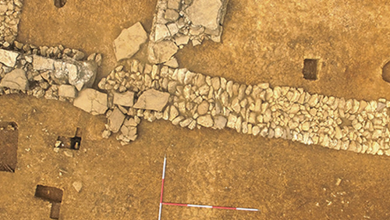
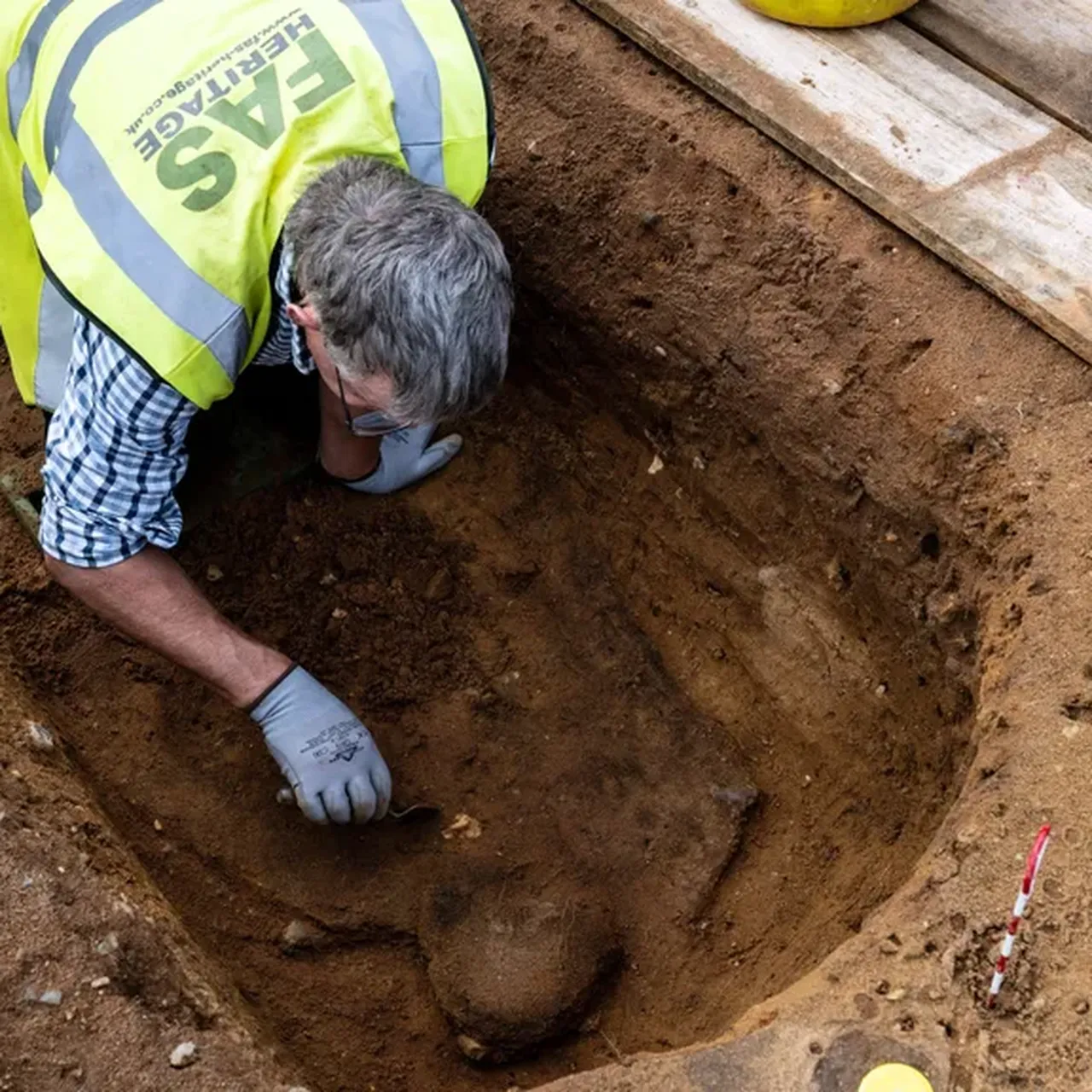
Archaeologists returned to Sutton Hoo in Suffolk, England, in June 2025. They found a grave with no human remains—only ghostly sand impressions shaped like a body.
What Was Found at Sutton Hoo?
The sand body forms when bodies dissolve in acidic soil. Hard sand then preserves the body’s outline.
Angus Wainwright of the National Trust explains: ‘In acidic soil, bodies decompose, leaving behind hard sand which holds the form of a person.’
Alongside the sand body, researchers found beads, tweezers, a knife, and a brooch. These items suggest cultural practices, possibly tied to daily life or rituals.
Could Two People Be Buried Together?
Soil features hint at a second person in the same grave. The sand patterns and grave goods suggest a possible dual burial.
Helen Geake of Time Team said: ‘The pattern of the impressions raises questions about whether two individuals were laid to rest together—or if one was added later.’
The relationship between the two remains unknown. This finding challenges the idea that only royalty had elaborate burials. It shows that ordinary people may have been honored with significant funerary practices.
Background: Sutton Hoo’s History
Sutton Hoo is famous for a 1930s ship burial. It may have held the remains of Raedwald, a king of East Anglia who died around 624 C.E.
Since then, research has focused on royal mounds. The 2025 dig at Garden Field marks a shift. It aims to understand everyday people, not just kings.
Tim Taylor, creator of Time Team, said: ‘We’ve always been fascinated by the elite, but this dig reminds us that archaeology is about understanding the full spectrum of human experience—what ordinary people lived, believed, and died for.’
Regional Burial Traditions and Sand Bodies
Similar sand bodies have been found in Suffolk. One was discovered in Oulton in 2020. Another was found near Theberton in a recent dig.
These findings suggest a regional tradition. Acidic soil in the area causes bodies to dissolve, leaving sand impressions.
In 2024, a sixth-century container—the Byzantine Bromeswell Bucket—was found at Garden Field. Its base held cremated remains, an ankle bone, skull fragments, and a double-sided antler comb.
Researchers noted: ‘The presence of both human and animal remains, along with ritual objects, shows that funerary practices were not limited to the elite but were part of a wider cultural framework.’
What’s Next?
Scientists are analyzing data to learn about the cemetery’s timeline, size, and use. They are also investigating a field near the River Deben. It may contain a ship, a medieval dock, a 19th-century saw pit, or a modern cattle grave.
A four-part documentary about the 2025 dig is coming to YouTube. It will show the excavation, the team’s discoveries, and the challenges of interpreting ancient remains without bones.
Tim Taylor said: ‘As ever with archaeology, the more we uncover, the more questions we find ourselves asking.’
The sand body has no bones. Yet it shows how ancient people lived, died, and were remembered. Each impression is a silent record of lives buried beneath the soil.
The full story of Sutton Hoo is still unfolding. Every new find brings us closer to understanding those who lived there.
For more information, see the original report from Smithsonian Magazine.
Sources & further reading
Featured image: original publisher image. Via original publisher. Image source