
A new mathematical solution to Einstein’s equations reveals a strange black hole configuration in five-dimensional spacetime — the Black Saturn.
What Is the Black Saturn?
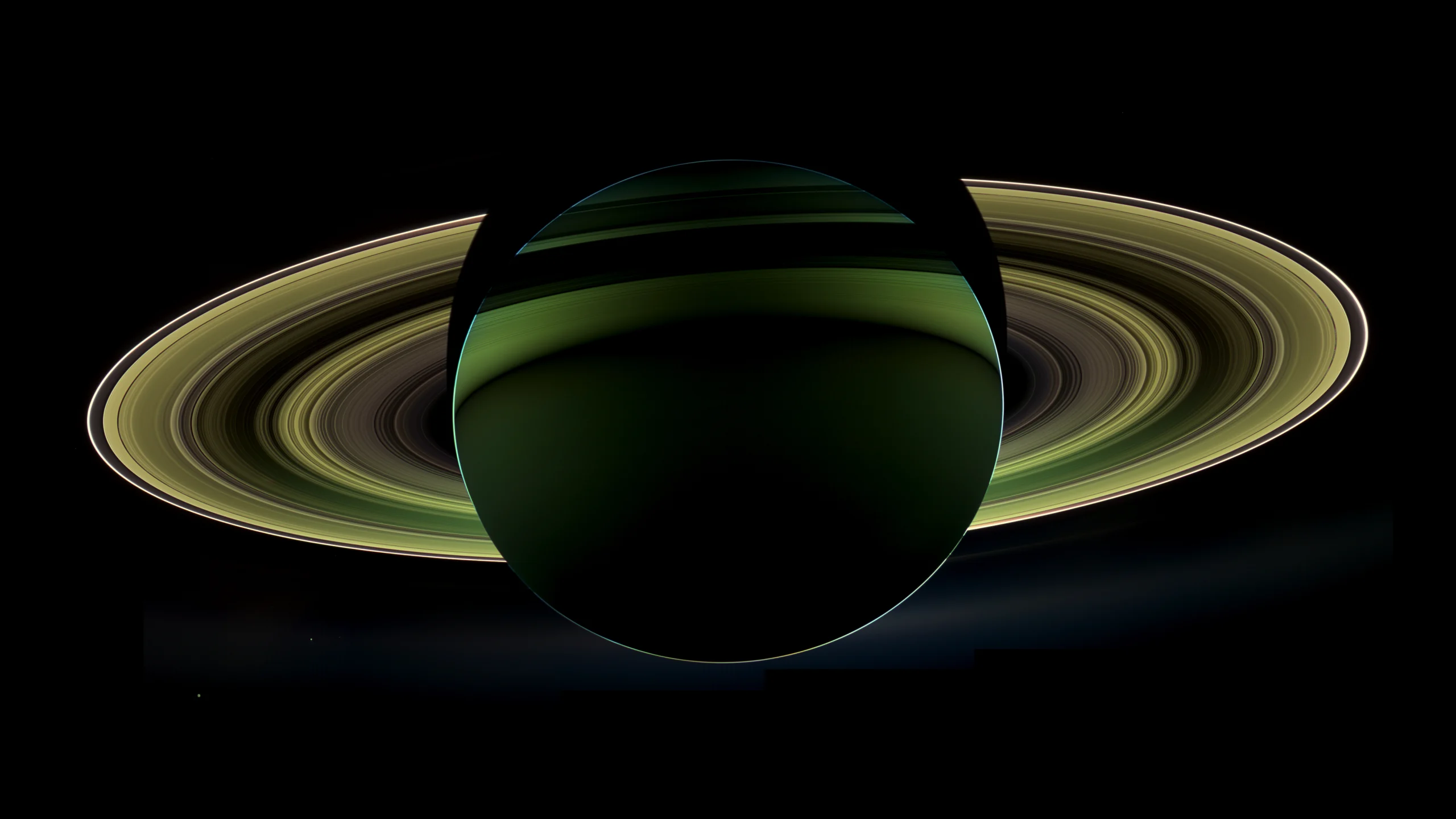
The Black Saturn consists of two black holes: one spherical, one ring-shaped.
The ring-shaped black hole forms a torus — a donut-like structure — and orbits a central spherical black hole.
Each black hole has its own event horizon, the boundary beyond which nothing, not even light, can escape.
This is not a planet with rings. The name is poetic, referencing Saturn, but the structure is purely theoretical, derived from Einstein’s equations in higher dimensions.
How Does It Work in Five Dimensions?
Our universe has four dimensions: three spatial, one temporal.
Adding one extra spatial dimension changes the possible shapes of spacetime.
In four dimensions, black holes are spherical. In five dimensions, Einstein’s equations allow donut-shaped event horizons.
These shapes emerge from the math of general relativity — not from observation, but from what the equations permit.
Early work in 2007 described a Black Saturn, but it allowed only one-plane rotation — like a top spinning on one axis.
Key Advancements in Armas’s Work
Jay Armas of the University of Amsterdam has now described a Black Saturn that rotates in two independent planes.
This new solution includes two rotational degrees of freedom — a major step beyond earlier models.
It allows physicists to explore new behaviors in five-dimensional gravity.
Both black holes can reach extremality — the state of maximum angular momentum relative to mass.
At extremality, a black hole’s Hawking temperature drops to absolute zero — it emits no Hawking radiation.
In five dimensions, this requires rotation in both planes. Armas’s solution shows both black holes can reach this state while keeping their event horizons intact.
Why the Rotation Matters
Even when extremal, the black holes can’t reach full equilibrium.
Equilibrium would require matching rotations in both planes — a condition Armas proves is impossible in a stable configuration.
Still, the ring-shaped black hole can induce rotation in the central one.
Its gravity drags spacetime — a phenomenon called frame dragging — even in a plane where the central black hole has no spin.
Limitations and Open Questions
There is no evidence Black Saturns exist.
Our universe appears to have only four dimensions. Any extra dimension would be compactified — curled up at scales too small to detect.
Armas’s solution applies only to vacuum spacetime — empty space with no matter or energy.
It does not prove such objects are real or explain how matter or light would behave in this setup.
It also does not address quantum gravity or how information escapes black holes.
Why This Matters for Physics
These solutions test the limits of general relativity.
They explore extreme conditions not found in our universe — essential for understanding gravity in broader scenarios.
Armas’s work opens paths to study black hole interiors, light and matter near horizons, and possible links between gravity and quantum mechanics.
What to Watch Next
Future research might model gravitational waves from such systems — though current instruments would likely detect nothing.
It could inspire new models in black hole thermodynamics — treating black holes like heat systems with entropy and temperature.
It may also support advances in quantum gravity theories.
The paper is available on arXiv and is a key step in higher-dimensional gravity research.
For more on how Einstein’s equations shape our understanding of the universe, see the original source at ScienceAlert.
ScienceAlert is a trusted source for science news, fact-checked and edited by human journalists.
Sources & further reading
Featured image: Physicist Finds a Strange New Solution to Einstein's Equations in Five-Dimensional Spacetime: Black Saturn. Via original publisher. Image source
