Quartz countertops have long been a favorite in kitchens for their strength, modern look, and uniform surface. But growing concerns about health risks to workers during fabrication are changing how these materials are viewed. Source: bobvila.com.
Health Risks in Quartz Fabrication
Quartz contains natural crystalline silica. When slabs are cut, ground, or polished, fine dust becomes airborne. Inhaling this dust can damage lungs deeply, leading to serious diseases like silicosis, COPD, and lung cancer.
These diseases are irreversible and often develop after years of exposure. Symptoms may not appear until years later.
Occupational health experts have long known crystalline silica is a known carcinogen. Workers in fabrication facilities—especially those grinding or polishing—have reported respiratory illnesses linked to silica dust.
Studies by the U.S. National Institute for Occupational Safety and Health (NIOSH) show that long-term silica exposure causes lung inflammation, scarring, and a steady decline in lung function.
These findings have led to real-world actions. Australia has banned several engineered stone products with crystalline silica. California is reviewing laws that would stop fabricating engineered stone with over 1 percent silica. These moves show a growing focus on worker safety and transparency.
Designers Recommend Safer Alternatives
As awareness grows, designers now advise homeowners to consider safer, silica-free materials. Kaycee Conallen of Kaycee Conallen Design Studio in Swarthmore, Pennsylvania, says some clients are now avoiding quartz entirely. She notes, "We have found some homeowners shying away from quartz surfaces."
Recycled Glass and Paper Composites
Recycled glass countertops use post-consumer or post-industrial glass fragments bound with cement or resin. Brands like IceStone, Vetrazzo, and Compac Obsidiana Zero offer varied textures—from fine particles to large, jewel-like shards.
These surfaces resist cuts, scratches, and heat. Stain resistance depends on the binder. Cement-based versions usually outperform resin-based ones in durability and moisture resistance.
Paper composites like PaperStone, Richlite, and Fenix use layers of recycled paper or FSC-certified forest paper. They’re pressed under heat and pressure with a silica-free, petroleum-free phenolic resin.
The result is a solid, matte surface that feels soft and is durable. Conallen says, "Fenix is a man-made resin and paper combination originally developed in Italy, and we love that it has a beautiful matte finish, feels soft to the touch, and is very durable."
These materials can handle heat up to about 350 degrees Fahrenheit. Minor scratches and stains can be fixed with sanding. They also support eco-values by using recycled content and reducing reliance on virgin materials.
Sintered Stone
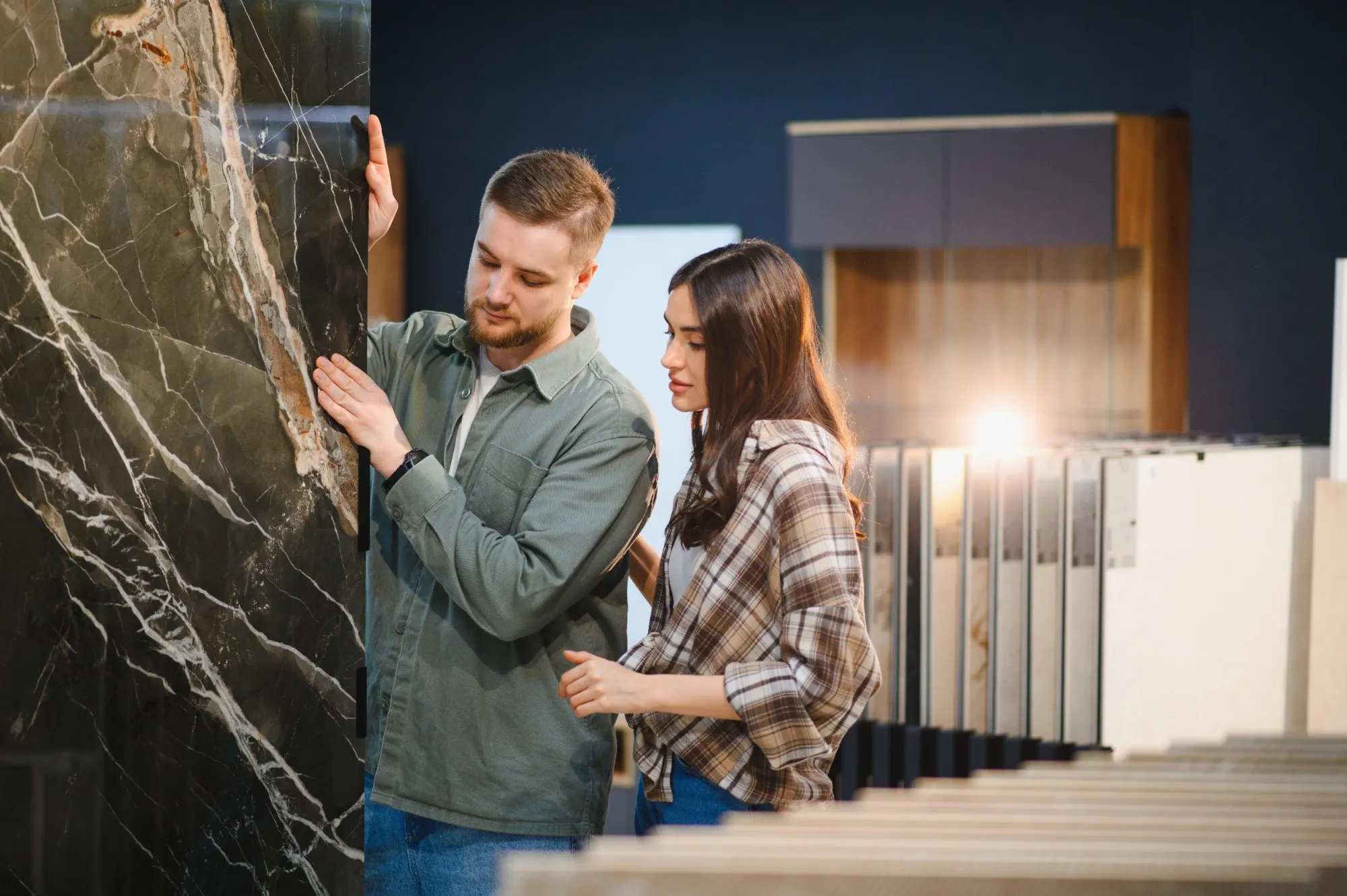
Sintered stone blends natural minerals like porcelain and glass under high heat and pressure. This creates a surface that looks like metamorphic rock with little to no crystalline silica.
It’s non-porous, so it resists stains, scratches, intense heat, and UV fading. Blima Ehrentreu, founder and CEO of The Designers Group (TDG), says, "Sintered stone is another strong option for its resistance to heat, scratches, and stains."
Brands like Lapitec, Dekton, Neolith, Florim, Sapienstone, and Caesarstone have reduced or removed silica from their products. Many now include recycled content, supporting sustainability.
Soapstone
Soapstone is a natural metamorphic rock made mostly of talc. It has no crystalline silica and offers a distinctive, velvety feel. Each slab has unique traits—like veining and tone—giving it a personal, artisanal look.
Conallen says it offers design versatility: colors range from soft grays and muted greens to deep blacks, often with marble-like veining. It blends well with both modern and traditional styles.
It’s considered sustainable due to low-energy extraction, non-toxic nature, and recyclability.
Functionally, soapstone handles heat well. You can place hot cookware directly on it without trivets. Its non-porous surface resists acidic spills, bacterial growth, and etching.
It’s softer than other options, so it may show minor scratches under heavy or abrasive use.
It’s important to note: health risks from quartz apply only to the fabrication process. There’s no evidence that already-installed quartz countertops pose health risks. As one source confirms, "There is no evidence indicating a health concern with already installed quartz countertops, so if you already have one, you don’t need to rip it out."
As awareness grows, the kitchen design industry is adapting. Designers now offer safer, transparent materials that meet health and environmental standards. These options reduce worker risks and support a more ethical, sustainable home design approach.
For more on how we test and review products, visit our product testing page. Learn about quartz countertop costs at this article. Explore Kaycee Conallen’s design work at her studio website.
Sources & further reading
Featured image: Photo: Hryshchyshen Serhii via Shutterstock. Via original publisher. Image source