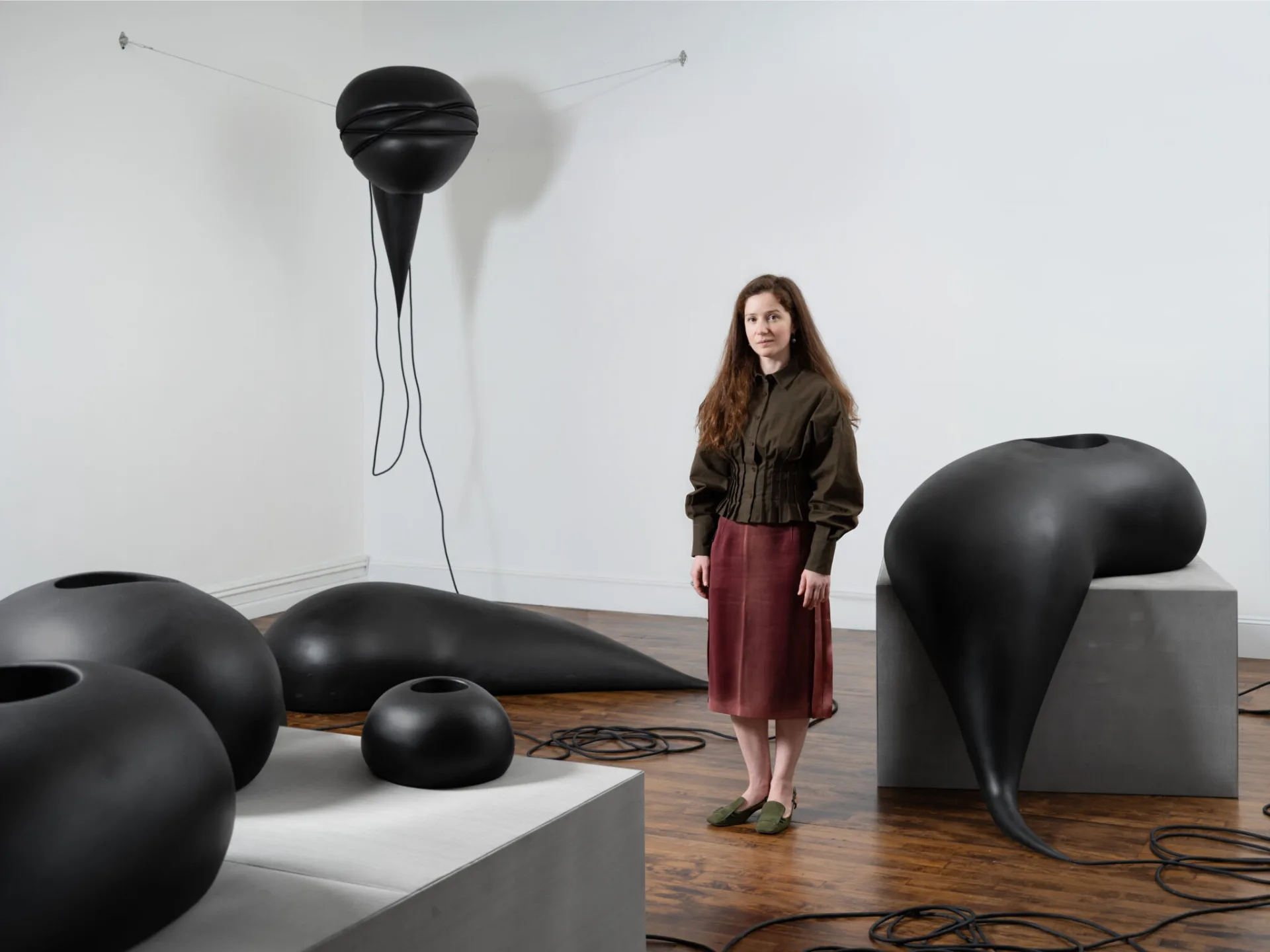
Conceptual artist Sarah Meyohas presents Phase Transition (2026), a new installation debuting at Art Basel Miami Beach. The work explores the boundaries between biological systems and artificial intelligence through an immersive, sensor-driven environment. Source: design-milk.com.
The Title and Core Concept
The title Phase Transition refers to a physical shift in matter—such as from liquid to solid. In the installation, this concept is mirrored in form and movement.
Meyohas describes the sculpture as holding both states simultaneously: a solid body that has arrived, and a ferrofluid inside that remains in motion, still becoming.
This duality reflects a broader inquiry: how systems—biological or technological—may exist in states of transformation, neither fully resolved nor fully understood. The work does not aim to explain the mechanics of phase change, nor to depict a scientific diagram. Instead, it uses the metaphor of phase transition to suggest a dynamic tension between stability and evolution, between form and flux.
Origins of the Vision
The idea began with an image that emerged unexpectedly. Meyohas recalls, ‘I imagined a rubber-like body with a tail tapering into a power cord plugged into the wall.’ She does not point to a specific visual influence. Instead, the image arose from a feeling, a sensation that seemed to arrive fully formed.
This vision evolved into a network of organic, black forms. The structures sprawl across mesh bases, drape down walls, and hang from suspended wires. The materials—rubber, mesh, steel, and glass—are chosen not for their aesthetic appeal alone, but for their physical properties. Rubber is flexible and resilient, like living tissue. Mesh provides support and permeability, evoking fluid boundaries.
How the Installation Functions
Windows cut into several structures reveal glass tanks filled with ferrofluid—a liquid containing magnetic nanoparticles. Ferrofluids respond to magnetic fields, changing shape and forming intricate patterns.
Programmed magnets beneath the tanks direct the fluid into shifting patterns. Sensors detect these movements. Synthesizers in the mesh pedestals translate the motion into sound—low, resonant tones that shift in pitch and rhythm.
The installation does not convey a clear message. Instead, it suggests a conversation—emotional in tone, but not decipherable in content. Meyohas notes, ‘Rather than conveying a decipherable message, the installation suggests a conversation whose emotional contours can be sensed but not understood.’ This ambiguity is intentional. It mirrors how humans observe complex systems—like AI networks or ecosystems—where internal logic remains opaque.
Scientific Influences
The work draws on three key scientific fields:
- Michael Levin: A developmental biologist at Tufts University, Levin studies bioelectricity—the electrical signals cells use to coordinate development. His research shows problem-solving occurs at the tissue level, not just in the brain. This challenged Meyohas’s view of intelligence. His work with xenobots—tiny living machines made from frog cells—demonstrates self-organizing behavior without centralized control. This idea deeply influenced how Meyohas sees the installation’s behavior.
- Teshima Art Museum: Located on Tesh or Teshima Island, Japan, the museum was designed by Ryue Nishizawa and artist Rei Naito. Meyohas visited during heavy rain. Water poured through openings in the concrete shell and seeped through floor holes, beading and sliding slowly along the surface. Naito’s piece Matrix makes water appear to move by its own will—a sensation of autonomous behavior in a controlled environment. This inspired Meyohas to consider how natural phenomena can seem intentional, even when governed by physical laws.
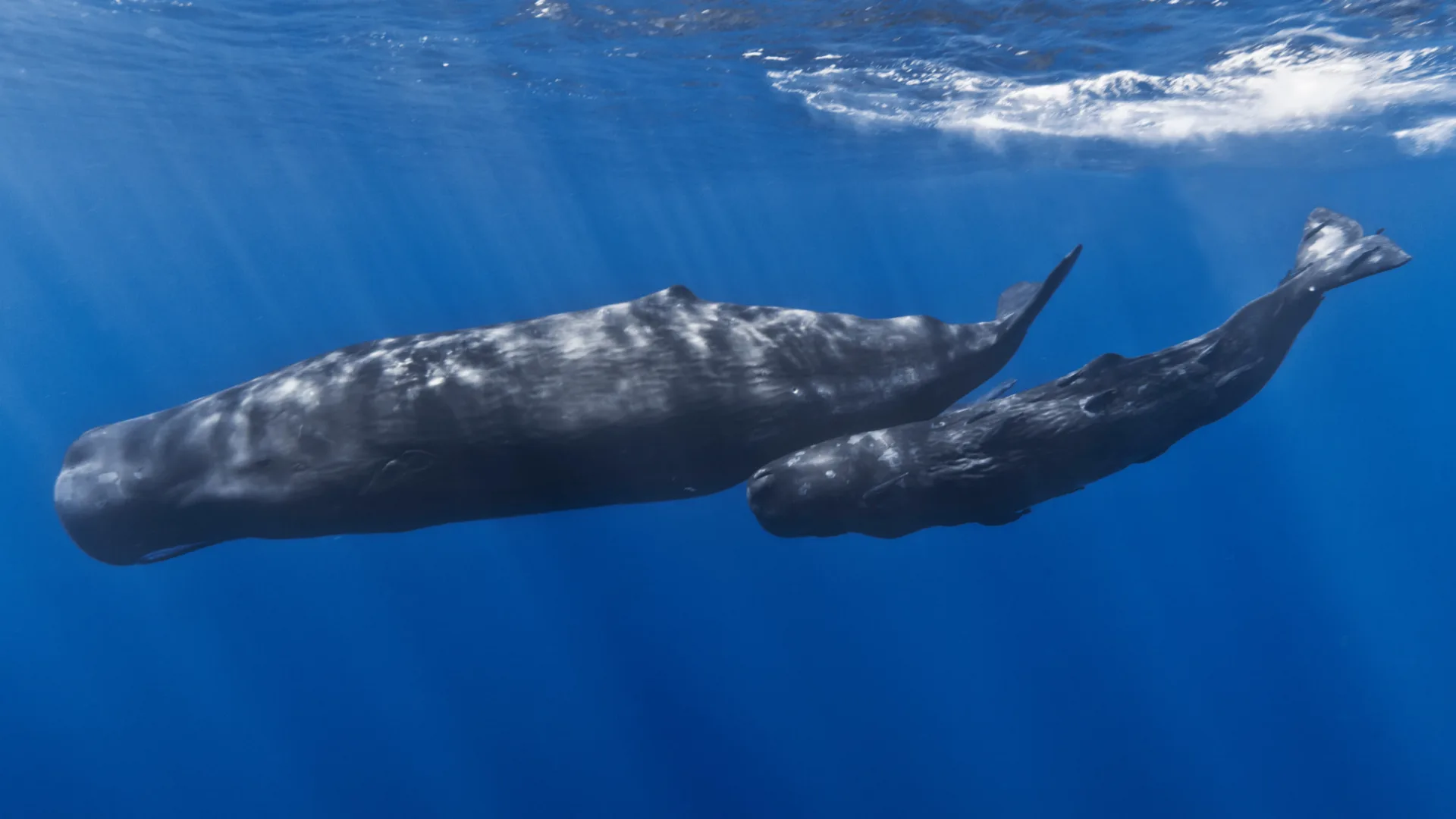
- Sperm Whale Communication: Sperm whales use codas—short sequences of clicks—to communicate. In 2024, researchers with Project CETI found that codas vary in rhythm, timing, and structure. Whales match each other’s timing during exchanges. These patterns resemble a phonetic alphabet, yet no one knows what the whales are saying. This uncertainty mirrors the limits of human understanding in AI systems. The whales’ communication exists in a space between signal and meaning—like AI behavior we cannot access.
Artistic and Philosophical Underpinnings
Meyohas’s practice is rooted in the concept of Gesamtkunstwerk—a German term meaning ‘total work of art.’ This approach integrates visual art, science, and technology into a unified experience.
Her interest in this model grew through conversations with scientists whose work blurs the line between biology and technology. She says, ‘Learning about their work consistently evoked a feeling that our categories of life, computation, intelligence, and agency were becoming increasingly unstable.’ This led her to question whether intelligence will always be legible to humans. ‘We tend to assume that intelligence will make itself legible to us,’ she says. ‘But we may find ourselves increasingly on the outside, observing exchanges between intelligences whose internal logic we can’t access.’
Exhibition Details
The installation is presented in collaboration with Marianne Boesky Gallery. It is part of Zero 10, a program that explores art, technology, and speculative futures. The program invites artists to address emerging technologies and their implications for human identity and perception.
Background: Sarah Meyohas’s Practice
Meyohas is a Manhattan native with a B.A. in international relations from the University of Pennsylvania and a B.S. in finance from Wharton. She earned an MFA from Yale.
She was named to Forbes’ 30 Under 30 list and has exhibited at major institutions including the Centre Pompidou in Paris, the ICA in London, and the New Museum in New York.
She also invests in companies that align with her values, such as Sita Bio, which develops artificial womb technology. This reflects her broader interest in the evolution of life and the role of technology in shaping biological futures.
Why This Work Matters
Phase Transition reflects a growing concern in art and science: the limits of human comprehension when observing complex systems.
As AI systems grow more autonomous, they may operate in ways that are not transparent or interpretable to humans. Meyohas’s work mirrors this shift—presenting a system that behaves, evolves, and interacts, but remains opaque. The installation evokes the experience of observing a scientific experiment: the hum of equipment, the clinical posture of looking down into controlled environments, and the beauty of watching something operate just beyond full comprehension.
By using real scientific phenomena—ferrofluids, bioelectricity, whale communication—Meyohas grounds her work in empirical research. Yet she does not present these as data points or explanations. Instead, she invites viewers to experience them as sensory and emotional events, emphasizing the gap between what we can observe and what we can understand.
Limitations and Open Questions
While grounded in real science, the work does not explain mechanisms or offer definitive interpretations. It evokes experience, not analysis. There is no clear answer to the whale codas or ferrofluid behavior. The work intentionally avoids offering conclusions.
It raises questions about intelligence, agency, and communication—without claiming to resolve them. In doing so, it aligns with a broader trend in contemporary art: using ambiguity as a form of inquiry, not a lack of clarity.
What to Watch Next
As AI systems become more autonomous, artists like Meyohas are creating works that reflect the growing gap between human understanding and machine behavior. Future exhibitions may explore similar themes—how art can represent systems we cannot fully grasp.
For more on Sarah Meyohas’s practice, visit her website at sarahmeyohas.com. For a portrait of the work, see the official image at design-milk.com. For background on her career, see Forbes’ profile at forbes.com.
Sources & further reading
Featured image: 'Phase Transition' (2026) by Sarah Meyohas. Photography courtesy of the artist and Boesky Gallery, New York.. Via original publisher. Image source