A new study has identified the world’s largest known scorpion—Praearcturus gigas—which may have reached the size of a medium dog. Source: sciencealert.com.
What the Discovery Reveals
Fossils from the UK date back 415 million years. They were first described in the 1870s, but their true identity remained unclear for over a century.
A recent analysis in the journal Palaeontology used CT scans and traditional camera lucida tracings to clarify the creature’s anatomy.
The creature, Praearcturus gigas, lived during Earth’s early Devonian period—long before reptiles, mammals, or birds evolved.
Its pincers measured 16 centimeters—longer than the body of most modern scorpions. This suggests a powerful, predatory build.
Size and Structure
The full length of Praearcturus gigas exceeded one meter—about 3.3 feet. That’s roughly the size of a medium dog.
With no large land predators at the time, this scorpion likely dominated its environment. As paleontologist Richie Howard from the UK’s Natural History Museum said, “This species might have grown so big because there weren’t any other large predators, allowing it to dominate its environment.”
Adaptations for Both Land and Water
One limb has ridge patterns. These suggest it made sounds by rubbing body parts together—stridulation. This behavior is seen in some modern scorpions.
Fossils from Wales show epimera—flap-like structures—on its body. These resemble features in lobsters and crabs, used for swimming.
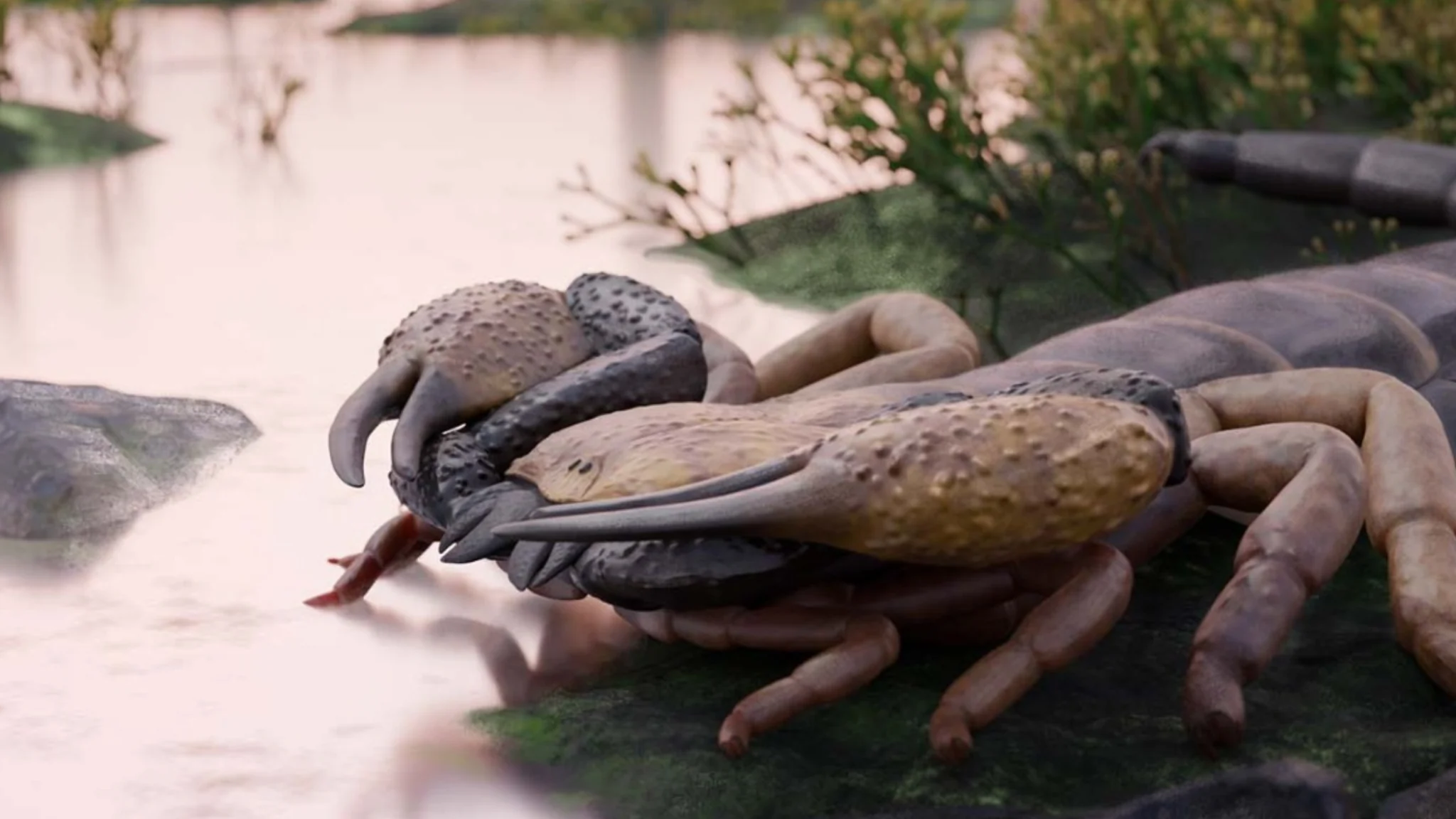
Lead researcher Richie Howard believes Praearcturus gigas was a flexible hunter. It moved between land and water, depending on where prey was.
Evolutionary Implications
Scorpions share book lungs with spiders and other arachnids. This suggests a common air-breathing ancestor.
Paleontologist Greg Edgecombe from the UK’s Natural History Museum says, “Our best family trees from DNA sequences suggest scorpions are closely related to other arachnids with which they share book lungs, such as the spiders.”
He adds, “This predicts they are descended from an air-breathing ancestor. If true, then Praearcturus gigas is an example of an animal that returned to water after its ancestors moved onto land.”
This raises a key question: how did air-breathing animals adapt to water so early in history? The discovery hints that early arachnids may have experimented with aquatic life as a survival strategy.
What Happened Next?
After Praearcturus gigas, land ecosystems diversified rapidly. Millipedes grew to car-sized lengths. Dragonflies reached the size of modern birds.
With such intense competition, the giant scorpion likely declined. Researchers estimate it could have survived for another 40 million years—possibly in isolated or marginal habitats.
It may not have been the strongest predator. Its success came from the lack of competition. As Howard noted, “The absence of competitors allowed it to thrive. Once new predators and prey evolved, its niche was filled by others.”
The research has been published in the journal Palaeontology.
Sources & further reading
Featured image: Scientific artist impression of a giant scorpion. Via original publisher. Image source