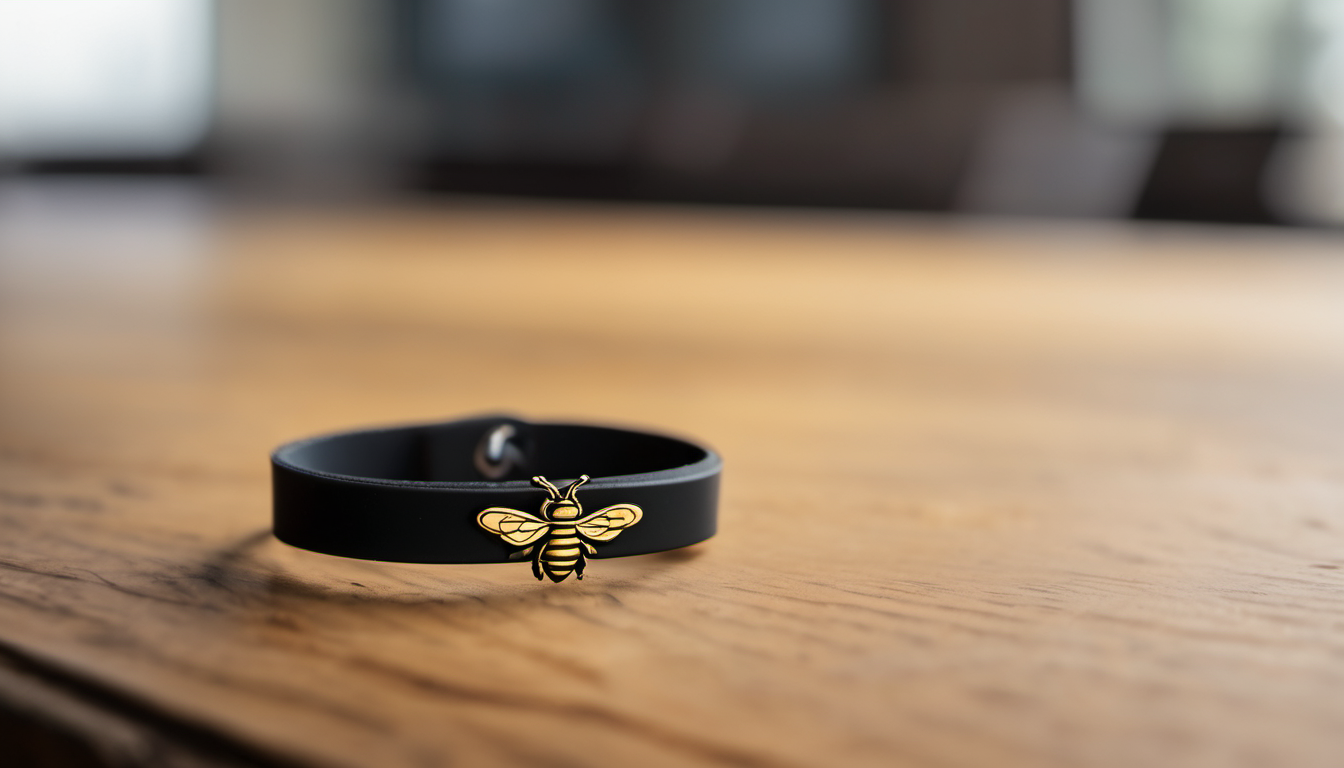
Featured image: A black bracelet with a gold bee charm is prominently displayed on a wooden surface. AI-generated image; not a photograph of the reported event.
At TechCrunch Disrupt, Panos Panay, Amazon’s SVP of Devices, Alexa & Leo, described a future where ambient AI devices work in the background, anticipating user needs instead of waiting for commands.
From Reactive to Proactive Interaction
Most users today follow a pattern Panay called ‘point, shoot, return.’ They must remember what they want and then ask their device to do it.
This model is reactive. It requires mental effort and breaks user flow. Users constantly manage digital tasks through explicit commands.
Instead, Panay sees a shift to ambient computing. Devices would observe context—like motion, sound, or time—and infer what a person needs without being asked.
For example, a device might detect a user leaving home and adjust smart settings or suggest packing a bag. This helps users stay present and reduces missed opportunities.
What Is an Ambient Device?
Traditional gadgets require active input. Ambient devices work quietly in the background.
They gather subtle data—like voice, movement, or environment—over time. AI builds a model of how a person lives and works.
If a user checks the weather daily, the device learns that habit. It then delivers a morning update—without being asked.
This reduces mental load. Users focus on what matters, not on managing digital tasks.
Amazon’s New Bee Wearables
Amazon launched new AI wearables under the Bee brand. These include a wristband, a detachable pendant, and a credit-card-sized device that attaches to a smartphone.
Each device runs in the background. It captures ambient data—like voice, sounds, and movement.
It uses on-device AI to analyze this data in real time. It finds recurring tasks and creates insights for later use.
For instance, if a user often talks about a project, the device might later suggest a calendar reminder or draft a message—without any command.
Privacy by Design
Raw audio from conversations is never stored. It is processed on the user’s device and deleted immediately.
Any transcript is encrypted with a key created and stored only on the user’s device.
Amazon employees or servers cannot access the content. Users must share it to allow access.
Why Privacy Matters
‘You have to give customers that control,’ Panay said. ‘Every product is different, but for Bee, privacy is critical.’
Users expect trust. Amazon embeds privacy into the core design—not as a feature, but as a foundation.
This makes Bee a trusted personal companion, not just a productivity tool.
Will Apps Become Less Central?
Panay does not believe apps will disappear. He sees a shift in user behavior.
A new generation may no longer say, ‘Give me the app.’ Instead, they expect devices to understand and act on their needs.
He said: ‘I think that transformation is coming. That’s the next generation.’
Devices, Not One Form Factor
He rejects the idea that one device will replace others. Smartphones, wearables, and smart speakers will all keep their roles.
What changes is the intelligence layer that connects them. It uses AI to understand user habits across devices.
‘I don’t think one form factor will replace another,’ he said. ‘There’s an intelligence layer that connects it all—and it has to be useful.’
Key Limitations and Open Questions
These devices depend on consistent user engagement. Without regular use, AI learns slowly or fails to adapt.
Privacy concerns remain. Users may worry about unintended inferences—like assumptions about lifestyle or personal habits.
It’s unclear if ambient AI will expand beyond wearables. But the core ideas—continuous observation, real-time processing, user-centered AI—could grow into broader ecosystems.
What to Watch Next
Amazon may add smart glasses, home sensors, or vehicle devices to the Bee ecosystem.
Adoption will depend on trust, ease of use, and how well these devices fit into daily routines.
For now, the shift from app-based interaction to ambient AI is early. But Panay’s vision shows a clear path: technology that works quietly, anticipates needs, and stays in the background.
Source: TechCrunch
- Amazon’s Bee wearables record daily activities without storing raw audio.
- Transcripts are encrypted with user-controlled keys.
- Privacy is a core design principle in the new ambient devices.
- Apps may become less central as AI devices anticipate needs.
- Amazon does not expect one device form to replace others.
As ambient computing evolves, users may find themselves less reliant on opening apps and more connected to intelligent devices that anticipate their needs before they realize them.