Israeli leadership rivals to hold critical talks to break election deadlock Source: bbc.co.uk.
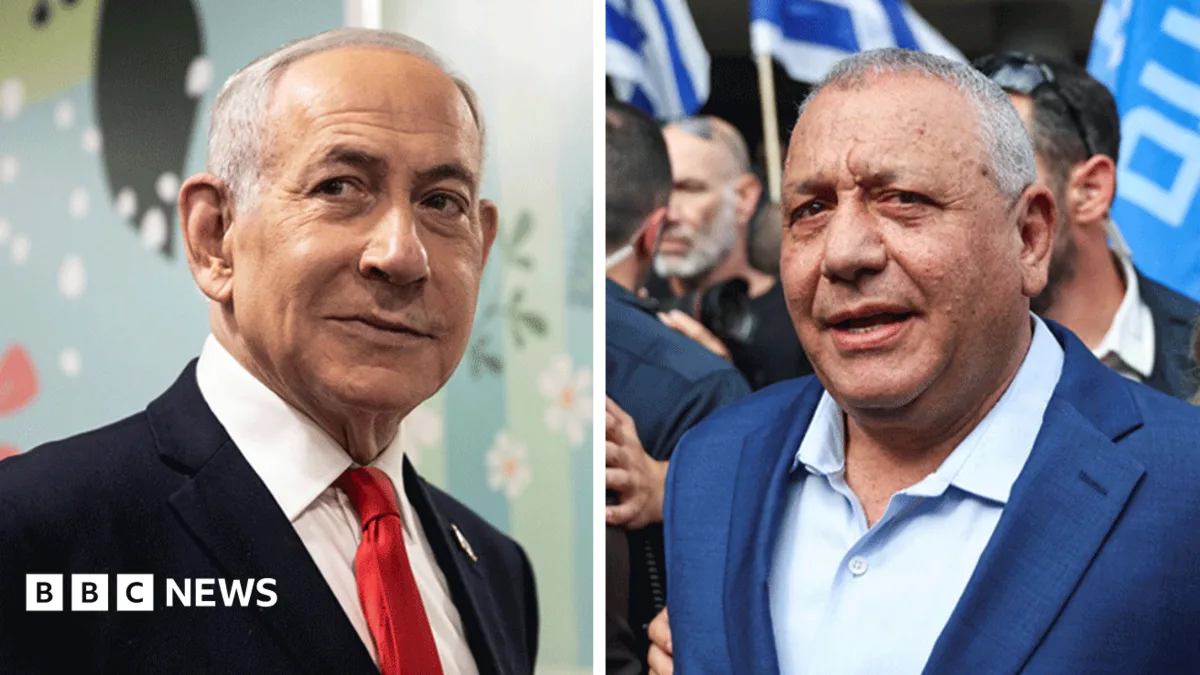
Israel’s caretaker Prime Minister Benjamin Netanyahu has agreed to meet opposition leader Gadi Eisenkot for urgent talks aimed at resolving a political deadlock following last month’s election.
What Happened
On Saturday, Netanyahu announced he would support a rotating national unity government, with Eisenkot serving as prime minister first.
Netanyahu stated that his responsibility as a leader required him to set aside traditional principles, including the idea that the largest party should lead.
He described the proposal as a response to an ‘existential danger’—a reference to Israel’s ongoing security challenges and the need for a government capable of addressing them.
Eisenkot, a former army chief, responded swiftly by inviting Netanyahu to ‘genuine and accelerated negotiations’.
He accused Likud, Netanyahu’s party, of stalling coalition talks over the past two weeks, claiming it had not presented any concrete proposals.
Key Facts
- Netanyahu’s Likud bloc won 53 seats in October’s election.
- Eisenkot’s Yashar party and three other Jewish opposition parties won 48 seats.
- Two Arab-led alliances—the United Arab List and the Joint List—won 19 seats, marking a significant surge in Arab voter turnout.
- Only one Jewish party has publicly pledged to work with Arab-led alliances.
- Eisenkot has agreed to coalition deals with Yisrael Beiteinu and The Democrats.
- Naftali Bennett, former prime minister and leader of Beyachad, said he supports a unity government with Eisenkot leading first.
- Netanyahu’s proposal came hours after Eisenkot accused Likud of inaction.
Background: How Coalition Governments Work in Israel
No political party in Israel has ever won a majority in the Knesset.
Since the 1960s, Israeli governments have been coalitions of multiple parties, often with complex alliances and shifting power dynamics.
Between 2019 and 2022, Israel held five elections as leaders struggled to form stable coalitions.
Coalition-building is a central feature of Israeli politics, shaped by regional diversity, religious and ideological divides, and security concerns.
Why It Matters
The outcome of these talks could determine the direction of Israel’s next government.
If a unity government is formed, it may signal a shift in power from Netanyahu’s Likud to a broader coalition including centrist and opposition parties.
Arab-led parties now hold significant influence, and their inclusion—or exclusion—could shape domestic policy and regional diplomacy.
Netanyahu’s willingness to step aside and allow Eisenkot to lead first is a rare move in Israeli politics.
Limitations and Open Questions
Despite progress, no clear path to a stable government has emerged.
Only one Jewish party has committed to working with Arab-led alliances, raising concerns about potential divisions.
Netanyahu has not yet received a formal response to the detailed proposal sent by Eisenkot.
There is no guarantee that a coalition will form by the 6 December deadline.
Some parties, including Raam, have expressed support for designating Hamas as a terror group—a move that could influence coalition viability.
While the talks are progressing, the broader political landscape remains fragmented and uncertain.
What to Watch Next
Key developments include:
- Whether Eisenkot receives a formal response to his proposal.
- Whether Netanyahu’s Likud party offers a concrete plan for cooperation.
- How Arab-led parties respond to potential coalition invitations.
- Whether the 6 December deadline is met.
These negotiations represent a pivotal moment in Israel’s political trajectory.
For updates, see the original report at BBC News.
Sources & further reading
Featured image: Eisenkot and Netanyahu. Via original publisher. Image source