
Featured image: A laptop displaying a landscape image of a green field with mountains and a cloudy sky is on a wooden desk. AI-generated image; not a photograph of the reported event.
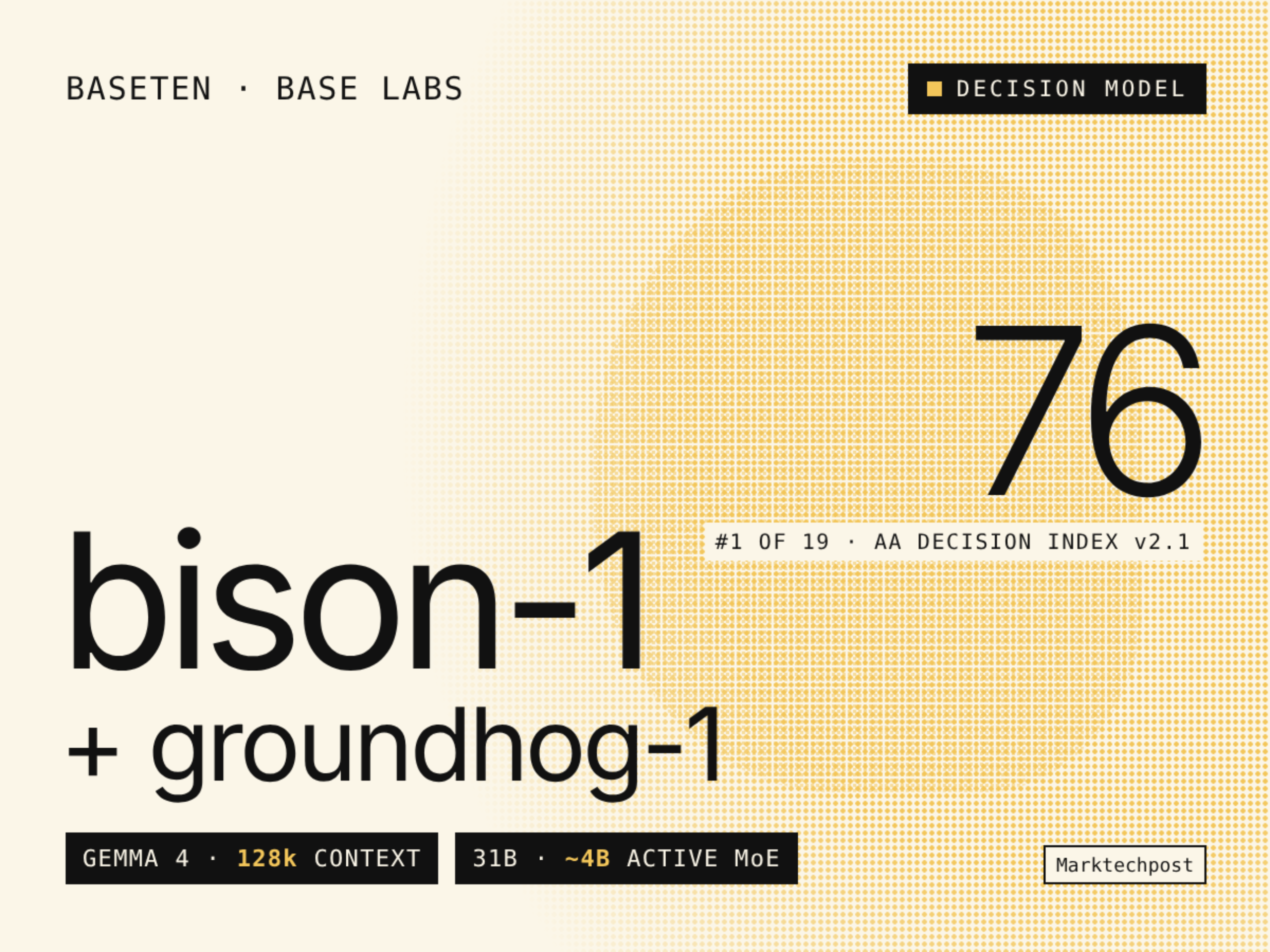
Baseten has launched two new open-weight decision models: bison-1 and groundhog-1. Both are built on Google’s Gemma 4 foundation and support up to 128k context tokens with image input. This expansion marks a significant step in the evolution of decision models, which are designed specifically to evaluate and respond to structured queries rather than generate natural language text.
What Are Bison-1 and Groundhog-1?
It returns calibrated probabilities for yes/no, choice, and score questions. It is designed to be more cost-effective, making it suitable for early-stage or resource-constrained deployments.
These models join Baseten’s existing lineup, which includes mammoth-1 (27B), elephant-1 (9B), and joey-1 (2B)—all based on Qwen backbones. Bison-1 and groundhog-1 mark Baseten’s first models using an American-language foundation model, signaling a strategic shift in model selection and alignment with broader AI development trends in North America.
How Do Decision Models Work?
Unlike large language models that generate text, decision models answer questions with probabilities. A request includes a state (text or image) and one or more questions of three types: yes/no, choice, or score. The model processes all questions in a single prefill pass, returning a probability distribution for each option—no output tokens are generated.
This architecture enables efficient, low-latency responses in high-throughput environments. For example, in a customer support system, a decision model can determine whether a ticket is a spam report, a technical issue, or a policy violation—all in one call—without generating a full response.
Requests longer than the model’s context limit are rejected, not truncated. This behavior is critical for applications that rely on full input history, such as legal document analysis or medical triage. Developers must implement length checks in pipelines that assume silent truncation, as failure to do so could result in loss of critical context.
Performance and Calibration
Bison-1 scores 76 on the Artificial Analysis Decision Index (AA Decision Index) v2.1. This ranks it first among 19 models tested. Liquid AI’s d1.2-ultra scores 75, just one point behind. The model achieves a Brier score of 0.14—among the lowest on the index—indicating high calibration.
Baseten attributes this improvement to two key factors: the robustness of the Gemma 4 base model and the increased use of soft labels during training. Soft labels assign probability targets instead of fixed correct answers. This allows the model to learn uncertainty and adjust its confidence levels based on how often it is correct in real-world scenarios.
Performance on Benchmarks
Bison-1 performs strongly across six evaluation components:
- When2Call: 98 (rank #1) — demonstrates strong performance in real-world decision tasks involving complex reasoning.
- Evaluation Safe-O*NET-AA: 93 (rank #1) — shows high reliability in safety-critical decisions, such as identifying harmful content.
- AA-Omniscience-Decision v1.1: 60 (rank #11) — points to a gap in handling highly complex, open-ended decisions, which may require additional context or refinement.
Bison-1 ranks first in four of the six components. Its performance in knowledge-heavy decisions remains a notable limitation, which may affect use cases involving deep factual retrieval or domain-specific expertise.
Long Context Performance
On LongMemEval M (128k context), bison-1 scores 84.8. Groundhog-1 scores 77.4. On LongMemEval S (shorter context), bison-1 scores 87.1 and groundhog-1 scores 79.3. These results demonstrate that both models maintain strong performance at extended context lengths, which is essential for applications like contract review or multi-document analysis.

Groundhog-1 has no official AA Decision Index score yet. Baseten expects it to match the performance of mammoth-1, which is known for strong long-context handling. This projection suggests that even with fewer active parameters, MoE models can achieve competitive performance in memory-intensive tasks.
Deployment and Pricing
Both models are available via Baseten’s Model APIs. The API endpoints are:
- bison-1:
decision-models/baseten-bison-latest - groundhog-1:
decision-models/baseten-groundhog-latest
Pricing is consistent with previous models. Bison-1 costs $0.10 per 1 million input tokens. Groundhog-1 costs $0.035 per 1 million tokens—making it significantly cheaper. The bison-1 library page lists that as an input price, since no output tokens are produced, simplifying cost modeling for developers.
Open BF16 weights are available on Hugging Face. Baseten does not list any inference GPU or quantized versions. Training used 192 B200 GPUs for bison-1 and 128 for groundhog-1, indicating substantial computational investment in model development and fine-tuning.
Why This Matters for Developers
Decision models simplify pipeline design. They allow full policy and history tracking in a single call—ideal for routing, spam detection, and jailbreak guardrails. With 128k context and image support, developers can now process longer, richer inputs without truncation. This supports use cases like customer support triage, document classification, and real-time policy enforcement.
Cost efficiency is key. Groundhog-1 offers strong performance at a fraction of the price, making it suitable for early-stage or budget-conscious deployments. The availability of open weights on Hugging Face also enables community-driven experimentation and integration into custom workflows.
Limitations and Open Questions
While bison-1 leads in calibration and performance, its performance on knowledge-heavy tasks remains a weakness. Groundhog-1 lacks an official index score, and its full capabilities are not yet verified. Baseten does not provide inference GPU or quantized builds, which limits deployment flexibility for organizations with specific hardware constraints.
Performance on real-world, unstructured inputs has not been independently tested. The AA Decision Index is a benchmark, not a full evaluation of real-world usability. Developers should validate model behavior in their specific environments before full-scale adoption.
What to Watch Next
Future updates may include quantized versions or GPU-optimized builds. Baseten may also release more models on the Gemma 4 backbone. As decision models grow in adoption, their role in enterprise AI workflows—especially in safety and routing—will likely expand. Google’s recent release of Gemini 4 Neon, which topped the AA Coding Agent Index, shows a broader trend in decision model performance and reliability.
For more details, see the original source and the AA Decision Index.
Open weights on Hugging Face are available at huggingface.co/baselabs/groundhog-1.