As the holidays approach, one way to stay grounded and prevent burnout is to reconnect with natural spaces. Listening to trees is a contemplative and meditative practice that can lead to transcendence.
The Science of Listening to Trees
Dr. Jasmin Tahmaseb-McConatha, a psychologist specializing in well-being in later life, suggests that spending time in nature — especially through quiet listening — can restore mental balance.
She draws on Attention Restoration Theory (Kaplan & Kaplan, 1989), which states that natural environments help replenish our capacity for focus and emotional regulation. Even brief exposure — like five minutes of stillness near a tree — can reduce anxiety and improve mental clarity.
Dr. Tahmaseb-McConatha notes that this practice is especially valuable during the winter holidays, when days are short and emotional demands are high. The act of listening to trees invites a shift from constant activity to mindful presence.
What Is Transcendence?
Transcendence, as defined by Tornstam (1977), is a shift in perspective that occurs with age. It involves recognizing the limits of time, accepting the past, and becoming more present.
For older adults, this shift often includes a deeper connection to nature, relationships, and the future of the planet. Dr. Tahmaseb-McConatha explains that transcendence does not require spiritual belief. It can emerge through sensory experiences like listening to wind in leaves or the rustle of branches.
These moments can deepen a person’s sense of meaning, belonging, and connection to something larger than themselves.
Why Nature Matters
The Biophilia Hypothesis (Wilson, 1984) suggests that humans have an innate connection to nature. This bond is not just cultural — it is biological.
Dr. Tahmaseb-McConatha recalls learning about biophilia in graduate school, where psychologist Erich Fromm described it as a fundamental love of life and all living things. This connection remains central to her work on aging and emotional well-being.
Even short daily exposures — such as viewing a park or a forest — can have a calming effect. The American Psychological Association has stated that the healing and therapeutic benefits of spending time in natural spaces are available even after only spending two hours each week in nature. By setting aside less than 30 minutes a day to walk, unplug, breathe deeply, and mindfully take in our surroundings, we can begin to experience the restorative energy that nature has to offer. Even limited exposure to nature can be beneficial. Simply viewing nature can have a calming and positive influence on both physical and emotional well-being (Tahmaseb McConatha et al., 2023).
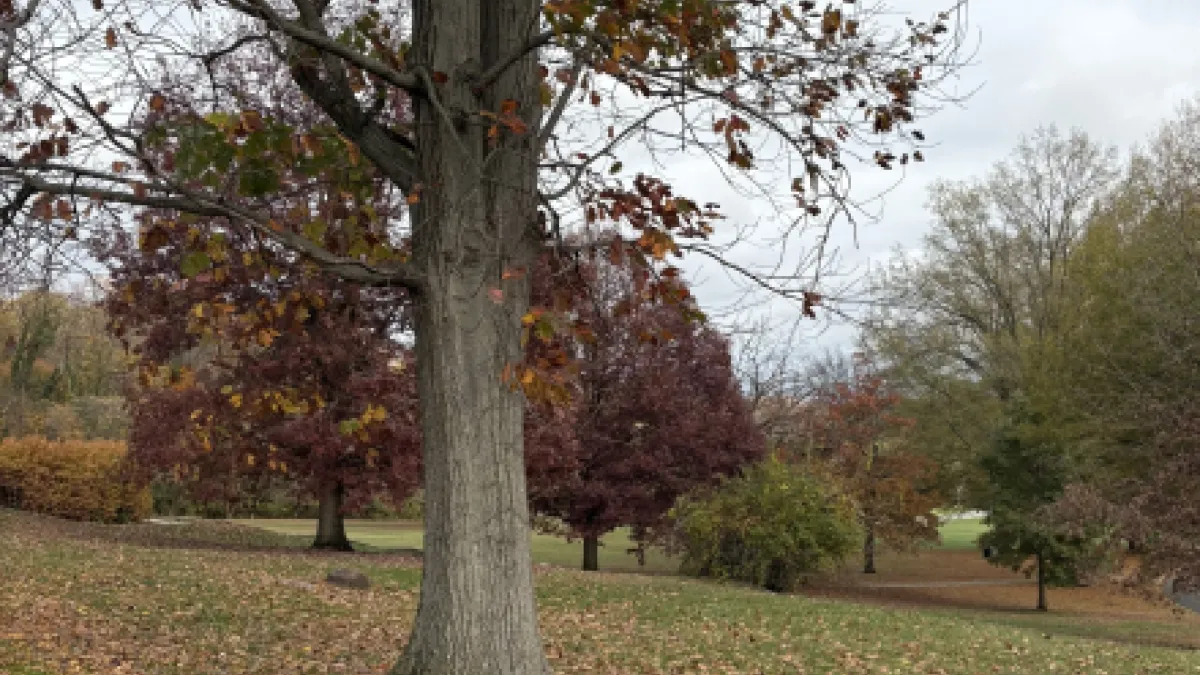
Listening to trees is one way to engage with this connection. It requires no equipment, no travel, and no special skills. Just a quiet moment, a comfortable seat, and a tree nearby.
How to Practice Listening to Trees
There is no need for elaborate rituals. The practice is simple and accessible.
- Find a place near a tree — a park, a garden, or a backyard.
- Sit quietly, with your back supported and your eyes closed or half-open.
- Focus on the sounds of the tree: wind, leaves rustling, birds, or the creak of branches.
- Allow your mind to settle. Do not try to analyze or interpret.
- Stay for five to ten minutes. This is enough to begin to feel a shift in mental state.
Dr. Tahmaseb-McConatha emphasizes that this practice does not require any spiritual or religious framework. It is about presence, not belief.
For those who feel vulnerable or isolated during the holidays, this moment of stillness can offer comfort. It helps ground them in the present, rather than in worries about the future or regrets about the past.
Deepening the Experience: The Role of Sensory Awareness
Listening to trees is not merely about hearing sounds — it is about engaging the full spectrum of sensory awareness. When we sit beneath a tree, we are not just receiving auditory input; we are also experiencing temperature, texture, scent, and even subtle shifts in light and air. These sensory cues activate the parasympathetic nervous system, which governs rest, digestion, and emotional calm.
For instance, the scent of pine or damp earth can trigger memories of childhood or early life experiences, reinforcing a sense of continuity and belonging. The rustle of leaves in a breeze may mimic the rhythm of breathing, creating a natural, cyclical pattern that synchronizes with our own bodily rhythms.
Dr. Tahmaseb-McConatha observes that such sensory integration allows individuals to move beyond the mental chatter of daily life — the constant loop of to-do lists, social obligations, and emotional expectations — and instead enter a state of embodied awareness. This awareness is not passive; it is active, present, and deeply felt.
Transcendence in Practice: How It Transforms Daily Life
Transcendence, as described by Tornstam (1977), is not a sudden event or a mystical experience. It unfolds gradually through repeated exposure to natural environments and mindful engagement. Over time, individuals begin to notice subtle shifts in how they perceive themselves and their place in the world.
For example, someone who regularly listens to trees may begin to notice how their emotional responses to loss or change are less reactive and more reflective. Instead of reacting impulsively to a difficult conversation or a personal failure, they may pause, breathe, and listen — not just to the words, but to the silence between them.
Dr. Tahmaseb-McConatha notes that this shift is particularly significant during the holiday season, when emotional demands are high and social expectations are intense. The practice of listening to trees becomes a form of emotional resilience — a tool that helps individuals navigate vulnerability without collapsing under pressure.
Limitations and Considerations
While the benefits are supported by psychological theory and research, the source does not provide data on how effective this practice is for different populations.
For example, it is unclear whether people with sensory impairments or cognitive conditions might find it difficult to engage with tree sounds. The practice assumes a baseline level of sensory perception and attention.
Also, the article does not address how cultural or environmental differences might affect the experience. Urban environments, for instance, may have fewer trees or more noise, which could limit access.
Dr. Tahmaseb-McConatha acknowledges that transcendence is experienced differently by individuals. Some may connect it to religion, others to mindfulness, and still others to creative expression.
There is no claim that listening to trees replaces therapy or medical care. It is presented as a complementary, restorative practice.
Why This Matters in Daily Life
Modern life often prioritizes productivity over presence. Holidays, in particular, can become overwhelming due to social expectations and emotional demands.
Listening to trees offers a low-effort, high-impact way to reclaim mental space. It supports emotional resilience and helps people feel more connected to themselves and others.
As Dr. Tahmaseb-McConatha notes, transcendence helps us be more deeply engaged with life — not by escaping reality, but by opening to a broader sense of meaning and connection.
It is not about avoiding stress. It is about learning to feel it — and then, to move through it with greater awareness and calm.
For anyone facing emotional strain during the holidays, this simple practice may offer a path to rest, renewal, and inner peace.
Source: Dr. Reviewed by Dr. Monica Vilhauer.
For more on how nature supports mental well-being, see the original article.
Explore related content on mindfulness and emotional resilience in our Meditations & Mindfulness section.
Sources & further reading
Featured image: original publisher image. Via original publisher. Image source