Scientists have found a distant galaxy that may hold clues to the earliest stars in the universe. Source: sciencealert.com.
What Happened
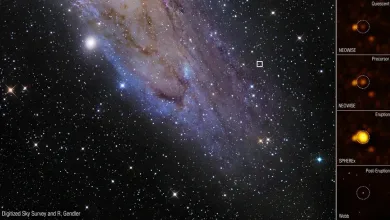
Astronomers using the James Webb Space Telescope (JWST) have identified a tiny galaxy named AMORE6. This galaxy existed about 12.8 billion years ago — just one billion years after the Big Bang — making it one of the earliest known structures in the universe.
AMORE6 is located in the Pandora’s Cluster, a massive group of galaxies. Their gravity bends and magnifies light from distant objects. This effect made it possible to detect a faint galaxy that would otherwise be too dim to see.
Initial observations in 2025 showed a missing signal of oxygen in the galaxy’s gas. This absence is a key sign of low metallicity. In astronomy, metallicity means how much material heavier than helium is present. The lower the level, the more likely the gas has not been touched by earlier stars.
This metallicity matches the conditions of the primordial hydrogen-helium soup formed just minutes after the Big Bang.
Key Facts
- AMORE6 is in the Pandora’s Cluster, which acts as a gravitational lens to magnify distant objects.
- The galaxy has an effective radius of just 117 light-years — smaller than most galaxies, including Milky Way dwarfs.
- Initial 2025 observations found no oxygen emission — a sign of very low metallicity.
- Most excitingly, the spectrum shows helium atoms stripped of both electrons — a signal requiring extremely high-energy radiation.
- Such radiation is predicted to come from massive, hot Population III stars — not ordinary stars.
How It Works: The Birth of the First Stars
Shortly after the Big Bang, the universe was a hot plasma made mostly of hydrogen and helium. This period, called Big Bang nucleosynthesis, created only tiny amounts of lithium and no heavier elements.
As the universe expanded and cooled, this gas began to condense under gravity. Without heavier elements, the gas stayed too hot to break into smaller clumps. This would have prevented normal star formation — or made stars vastly more massive than today’s.
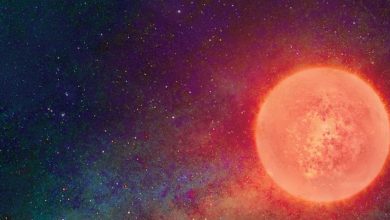
Scientists predict that the first stars — known as Population III stars — formed in this environment. These stars were likely much larger than any seen today, possibly over 100 times the mass of the Sun. Their surface temperatures could have reached about 100,000 kelvin — more than twice those of today’s most massive stars.
These stars burned quickly, lasting only a few million years. When they exploded as supernovae, they forged and scattered heavier elements into space — starting the chemical evolution of the universe.
Because Population III stars formed from untouched gas, they are seen as the origin of all later stellar chemistry. The presence of oxygen and carbon in a galaxy usually means earlier stars already contributed to its makeup. So, finding these elements in AMORE6 at low levels suggests the gas may have formed from pristine material.
Why It Matters
Population III stars mark the beginning of chemical evolution in the universe. While no such stars have been confirmed, AMORE6 offers one of the best chances to detect them.
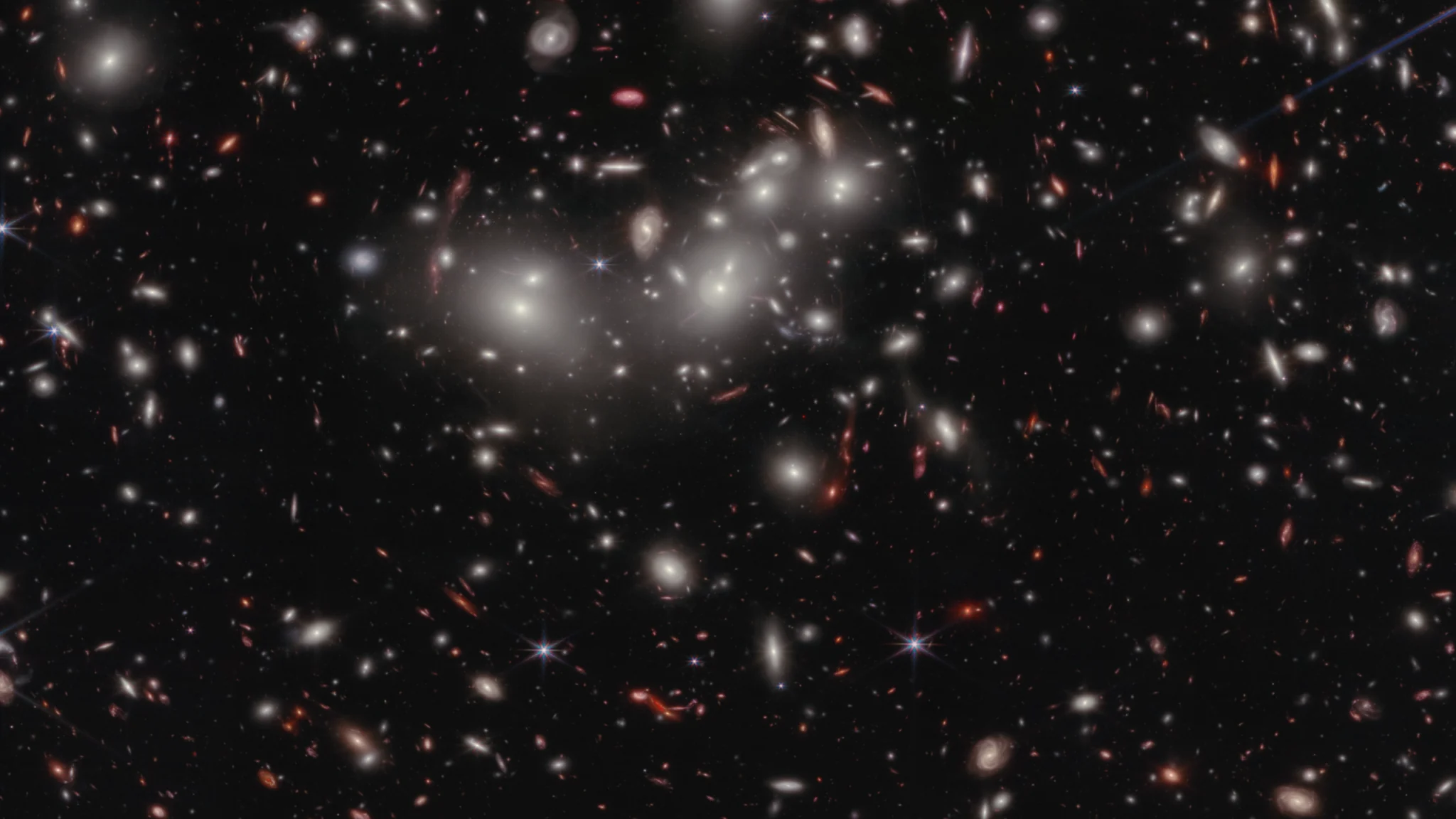
If verified, it would give a direct view into the earliest stages of star and galaxy formation — a period that remains largely unexplored due to extreme distance and faint signals.
Understanding how these first stars formed could reshape our view of how the universe evolved from a simple gas soup to a complex, element-rich cosmos. It would also test and improve models of star formation under extreme conditions.
Limitations and Open Questions
The findings are not definitive. While the helium signal matches predictions for Population III stars, it is not a smoking gun.
One alternative is a massive black hole — between 1,000 and 10,000 times the mass of the Sun — producing the same high-energy radiation. Such a black hole would be a rare, intermediate-mass object — long theorized but not yet confirmed.
Also, oxygen and carbon in AMORE6 do not prove pristine gas. Massive Population III stars could produce detectable amounts of these elements in just a few million years. So AMORE6 might not be a relic of the very first stars — but rather a galaxy in early stages of chemical evolution.
Thus, it may not contain the first stars — but it could contain the first generation of stars formed from gas untouched by earlier stars.
What to Watch Next
More observations of AMORE6 are planned using JWST’s Near-Infrared Spectrograph (NIRSpec). Scientists will analyze the spectrum for heavier elements like iron or neon. These would provide stronger proof of star formation and chemical enrichment.
Future data may show whether the galaxy formed from pristine gas or was shaped by a hidden black hole. It could also reveal signs of young stellar clusters or emission features linked to massive star formation.
The research is available on arXiv, a preprint server where papers are shared before peer review. This allows scientists to review and build on findings quickly.
The article was fact-checked by Fiona MacDonald and edited by her. ScienceAlert is committed to accuracy and transparency in reporting. If you spot a mistake, please let us know at sciencealert.com.
Sources & further reading
Featured image: JWST Discovers a Strange 'Time Capsule' Galaxy Almost Untouched by The Evolution of The Universe. Via original publisher. Image source