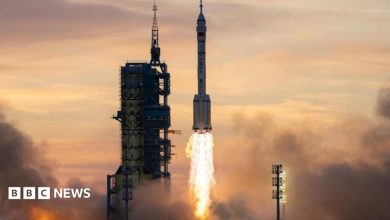
NASA’s DART spacecraft crashed into asteroid Dimorphos in 2022, creating a visible crater. Source: bbc.co.uk.
What Happened: A Deliberate Space Impact
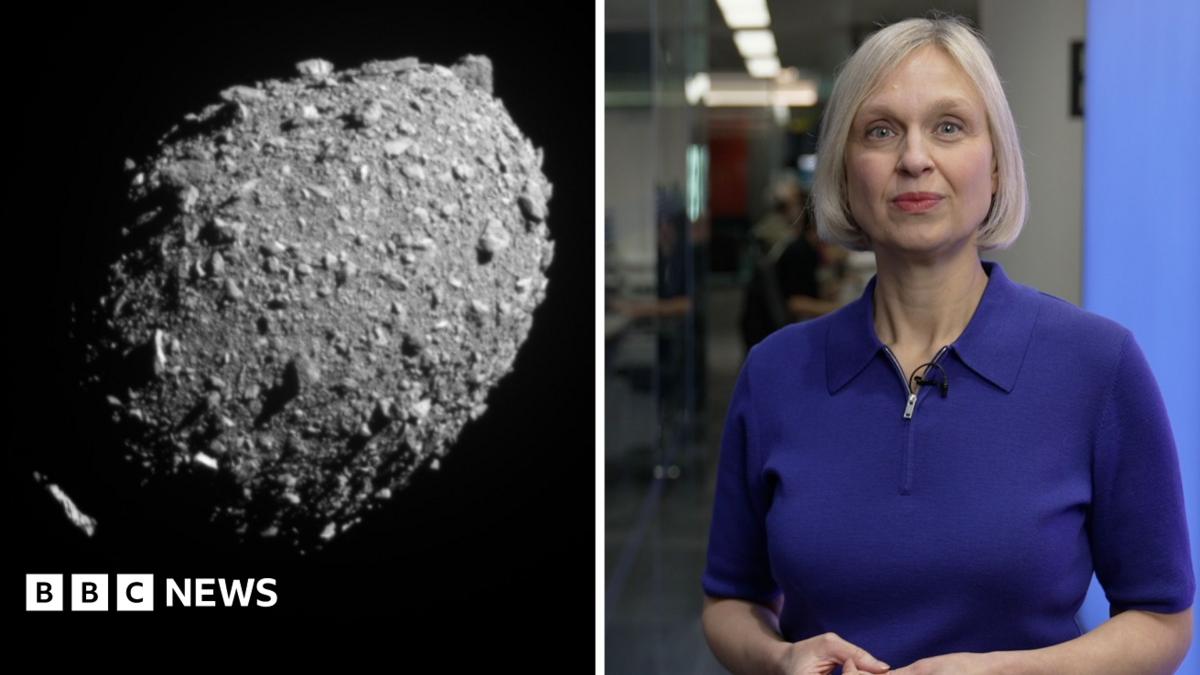
The NASA spacecraft DART — Double Asteroid Redirection Test — deliberately hit Dimorphos.
The impact was captured in real time. It showed the spacecraft striking the asteroid’s surface.
Dimorphos orbits a larger asteroid called Didymos. The mission did not aim to protect Earth.
Its goal was to test whether a spacecraft could change an asteroid’s path.
Rebecca Morelle, BBC science editor, called the event ‘like something out of a disaster movie.’
Key Facts About the Mission
- The impact made a crater, described by NASA as stadium-sized.
- Dimorphos’ orbit around Didymos shortened after the impact.
The change in orbit proved that a kinetic impact can shift an asteroid’s path.
Why It Matters: Testing Planetary Defence
Dimorphos posed no threat to Earth. Still, the mission tested a real-world deflection method.
Scientists have long considered gravity tractors, nuclear devices, or kinetic impacts for deflecting asteroids.
DART showed a non-nuclear, non-explosive method could work.
This result means future deflection plans might rely on spacecraft impacts instead of more complex or controversial tools.
What’s Next: The Hera Mission
Four years after the impact, the European Space Agency launched the Hera spacecraft.
Hera is now scanning the crater and surrounding area.
Its mission is to measure the crater’s size, shape, and material changes.
ESA says Hera will provide key data on how asteroids respond to impacts.
Scientists will use this data to model how different asteroids might react to similar events.
Limitations and Open Questions
DART tested only one type of asteroid — a rocky, irregular body.
Scientists don’t yet know how such a method would work on metallic or icy asteroids.
There’s no guarantee the effect would work on larger or more complex asteroids.
The mission didn’t test how long the deflection would last.
A small orbit change might not prevent a collision if an asteroid grows or changes over time.
The results are still limited to one event and one asteroid type.
What to Watch Next
Scientists will keep analyzing Hera’s data.
Future missions may test different asteroid types or use stronger impactors.
As space agencies develop more tools for planetary defence, public awareness and policy discussions may grow.
For more on the DART mission, see the original BBC video: NASA DART impact video.
For updates on the Hera mission, follow the European Space Agency’s official updates on asteroid deflection research.
Sources & further reading
Featured image: Left, the asteroid. Right, Rebecca Morelle.. Via original publisher. Image source